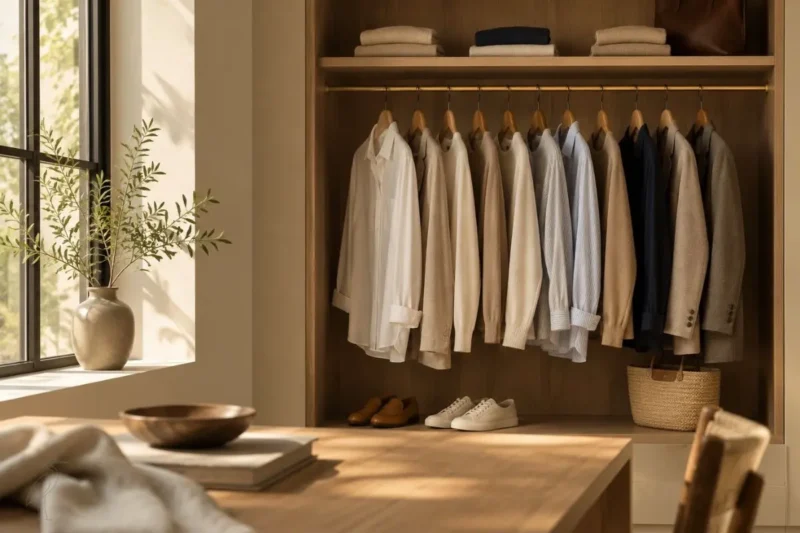
What does a quiet wardrobe give you?
A quiet wardrobe gives you more than style—it gives you confidence through familiarity. When you know your clothes fit well, work together, and support your daily life, getting dressed requires less thought. That confidence isn’t about owning more or dressing perfectly. It’s about freeing your attention for the people, work, and moments that matter most.
There comes a point when getting dressed stops feeling like a daily decision.
You open the wardrobe, reach for the linen shirt you’ve worn dozens of times, the trousers that always sit just right, the sandals you’ve trusted all summer. The outfit isn’t exciting because it no longer needs to be. It simply works. You leave the house without wondering whether you’ve chosen correctly, and your attention moves almost immediately to the rest of the day.
That quiet shift is easy to overlook. We often assume confidence comes from owning more, discovering the perfect piece, or finally feeling as though we’ve mastered personal style. More often, confidence grows through familiarity. It arrives when your wardrobe becomes settled enough that getting dressed fades into the background, leaving more room for the conversations, work, and ordinary moments that deserve your attention.
Confidence Isn’t Built in the Closet
For a long time, I assumed confidence lived one purchase away.
Not because I wanted more for the sake of having more, but because I genuinely love beautiful clothing. I appreciate exceptional fabric, thoughtful tailoring, and the quiet satisfaction of finding something that is made extraordinarily well. This isn’t an argument against fashion, nor is it a call to own as little as possible.
What changed was realizing how often I had been buying for an imagined version of my life rather than the one I was actually living.
I collected pieces for occasions that rarely arrived, wardrobes that belonged to different routines, and aspirations I hoped would eventually become everyday reality. The wardrobe grew, but getting dressed never became easier.
Over time, I began paying less attention to what I admired in theory and more attention to what I reached for without thinking. The clothes that earned my trust weren’t always the most exciting. They were the ones that fit well, moved comfortably through my day, and quietly supported the life I already had.
That shift changed my understanding of confidence.
It wasn’t built through accumulation. It grew through familiarity. Through wearing the same pieces often enough that I stopped questioning them. Through discovering which silhouettes felt like myself, which fabrics held up to real life, and which combinations quietly did their job without asking for attention.
Eventually, the wardrobe stopped being a place to search for confidence and became something much simpler: a collection of trusted pieces that supported the life I was already living.
That is the difference between dressing to become someone and dressing from a place of knowing who you already are.
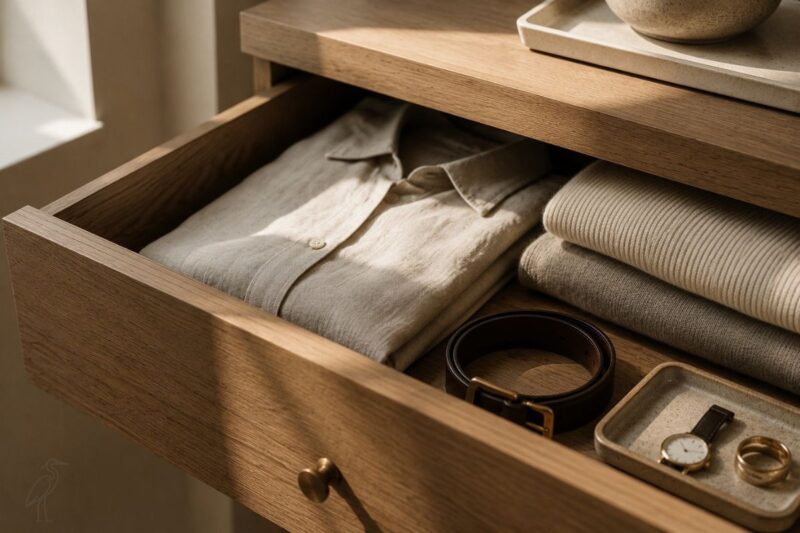
What “Enough” Actually Feels Like
“Enough” is one of those words that sounds measurable until you experience it.
“Enough” isn’t really a number at all—which is why I hesitate whenever someone asks exactly how many pieces a wardrobe should contain. The better question is whether your wardrobe feels settled enough to support your life with ease. If you’re thinking through both the practical and philosophical side of that question, How Many Pieces Should a Capsule Wardrobe Have? explores the numbers, while How to Wear a Capsule Wardrobe That Actually Works explores what happens once you’ve built one.
It isn’t a particular number of pieces, a perfectly organized wardrobe, or the moment you’ve finally found every essential. In fact, most people don’t recognize “enough” because they’re looking for completion when what they’re actually need is confidence.
A quiet wardrobe begins to feel like enough when getting dressed stops feeling like a problem to solve.
You already know which trousers you’ll reach for on a busy morning. You trust the shirt that works just as well for lunch as it does for an afternoon meeting. You no longer stand in front of the wardrobe wondering whether you have anything to wear, because you know the answer before you open the door.
The wardrobe hasn’t become larger.
It has become more familiar.
That familiarity changes the experience of getting dressed in subtle ways. You spend less time negotiating with yourself, less energy chasing the feeling that one more purchase will finally complete the collection, and more time simply living in the clothes you’ve already chosen well.
This is why a quiet wardrobe rarely feels restrictive.
It doesn’t offer endless possibilities.
It offers trusted ones.
And over time, those trusted choices become something far more valuable than variety: they become a quiet kind of certainty.
A Quiet Wardrobe Gives You More Than Style
When a wardrobe finally settles into place, something unexpected happens.
The clothes themselves begin to matter less.
Not because they’ve become ordinary, but because they’ve become familiar enough that they no longer compete for your attention. You stop evaluating every outfit before leaving the house. You stop wondering whether something else might have been a better choice. The energy that once went toward deciding, adjusting, and second-guessing begins to return to you.
That is the quiet gift of “enough.”
A wardrobe doesn’t simply change how you look. It changes how you move through your day.
More Attention
Attention is one of the most valuable things we have, yet much of it is spent on surprisingly small decisions.
What should I wear today?
Does this work together?
Should I change before I leave?
Individually, those questions seem insignificant. Repeated day after day, they become a quiet drain on your attention.
A settled wardrobe doesn’t eliminate choice, but it softens it. The decisions become familiar, leaving more space for your work, your conversations, your family, and the moments that deserve your full presence.
More Consistency
A quiet wardrobe also allows you to become more recognizably yourself.
Instead of constantly experimenting with different versions of who you think you should be, your style begins to develop through repetition. Certain silhouettes return. Certain colors become unmistakably yours. The people around you stop noticing what you’ve chosen to wear because the clothing feels naturally aligned with the person wearing it.
Consistency isn’t the absence of creativity.
It’s often the result of clarity.
More Confidence
Confidence doesn’t usually arrive all at once.
It accumulates quietly.
A jacket you’ve worn through dozens of meetings. Shoes you’ve walked miles in. A shirt that always feels right the moment you put it on.
Over time, these pieces stop feeling like clothing and begin feeling like trusted companions. You know how they’ll fit, how they’ll move, and how they’ll support your day.
That is confidence through familiarity.
The same principle extends into professional life, where the most authoritative wardrobes are rarely the most expressive. They inspire confidence because they are familiar, reliable, and quietly supportive of the work being done. I’ve explored that idea more deeply in Dressing for Quiet Authority, but the foundation is the same: confidence grows when your clothing no longer competes for your attention.
More Room for Life
Perhaps the greatest change isn’t found in the wardrobe at all.
It’s found in what the wardrobe makes possible.
Lunch that turns into an afternoon conversation.
An invitation accepted without wondering what you’ll wear.
Packing for a weekend in minutes instead of hours.
Leaving the house with your attention already focused on where you’re going rather than how you look.
The wardrobe quietly steps back.
Your life quietly steps forward.

Why Familiarity Feels Like Freedom
We often think freedom comes from having more options.
More clothes. More combinations. More possibilities.
Yet the opposite is often true.
The more decisions a wardrobe asks us to make, the more attention it quietly requires in return. Every unfamiliar piece brings new questions. Does this work with what I already own? Will I actually wear it? Does it fit the version of my life I imagined when I bought it?
Those questions are not a sign that something is wrong. They are simply the natural result of living with too many unresolved decisions.
Familiarity resolves them.
When you’ve worn the same linen shirt through countless mornings, you no longer wonder how it will feel by lunchtime. When your favorite trousers have accompanied you through work, travel, and ordinary weekends, you stop evaluating them every time you put them on. Trust replaces deliberation.
That trust creates an unexpected kind of freedom.
Not the freedom of endless choice, but the freedom of no longer needing it.
Your attention is no longer spent negotiating with your wardrobe. It becomes available for the things that deserve it more: the conversation across the table, the meeting you’ve prepared for, the walk home at the end of the day, the quiet satisfaction of feeling completely present where you are.
Perhaps this is why repeating outfits eventually stops feeling repetitive. Familiarity doesn’t diminish enjoyment—it deepens it. Every time you return to the same trusted combination, you’re reinforcing confidence rather than sacrificing creativity.
The most settled wardrobes often look remarkably repetitive from the outside.
From the inside, they feel anything but.
They feel effortless.
The Quiet Luxury No One Sees
When people talk about quiet luxury, the conversation often begins with materials.
Cashmere. Linen. Leather. Beautiful tailoring. Understated color palettes.
Those things matter. Well-made clothing is often more comfortable, more durable, and more enjoyable to wear. They are part of what makes a wardrobe feel considered.
But they are not the quietest luxury.
The quietest luxury is reaching the point where your clothes quietly do their job.
You trust that your wardrobe works because you’ve built it with intention. The pieces relate to one another. They fit your life. They ask very little of your attention in return. Instead of wondering what to wear, you simply get dressed and move into the rest of your day.
That is why I often return to the importance of building a strong foundation before adding more. A wardrobe of trusted essentials creates far more freedom than an endless collection of possibilities. (Explore Quiet Luxury Wardrobe Essentials for the pieces that form that foundation.)
And if you’re still building that foundation, remember that it doesn’t happen all at once. A quiet wardrobe is assembled gradually—through thoughtful choices that continue earning their place over time. (If you’re starting from the beginning, How to Build a Quiet Luxury Wardrobe walks through that process step by step.)
Quiet luxury isn’t simply about owning beautiful things.
It’s about reaching the point where those beautiful things quietly support a beautiful life.
When Enough Becomes Confidence
There is rarely a moment when a wardrobe suddenly feels complete.
More often, the change is so gradual that you only recognize it in hindsight.
One morning, you realize you haven’t stood in front of the wardrobe wondering what to wear in weeks. You pack for a weekend without making extra piles “just in case.” You accept an invitation without mentally calculating whether you own the right outfit.
Nothing dramatic has happened.
Your wardrobe has simply become familiar enough that it no longer asks to be the center of your attention.
That quiet confidence has very little to do with owning less, and everything to do with knowing what already serves you well.
The pieces you’ve chosen have earned your trust. They fit your life. They support your work. They move with you through ordinary days without asking for recognition.
Eventually, getting dressed becomes less about deciding who you want to be and more about stepping into the life you’re already living.
Perhaps that is what “enough” has meant all along.
Not a perfectly complete wardrobe.
But the quiet confidence of knowing your attention belongs somewhere else.
Confidence grows through familiarity.
Enough becomes easier to trust when you give yourself space to choose carefully, return to what already works, and let familiarity replace the pressure for constant novelty.
What if every new piece had to earn its place?
The Quiet Wardrobe Lens is the same framework I use to decide whether something belongs in my wardrobe before I bring it home. It’s free, practical, and designed to help you build confidence through thoughtful repetition rather than constant replacement.

