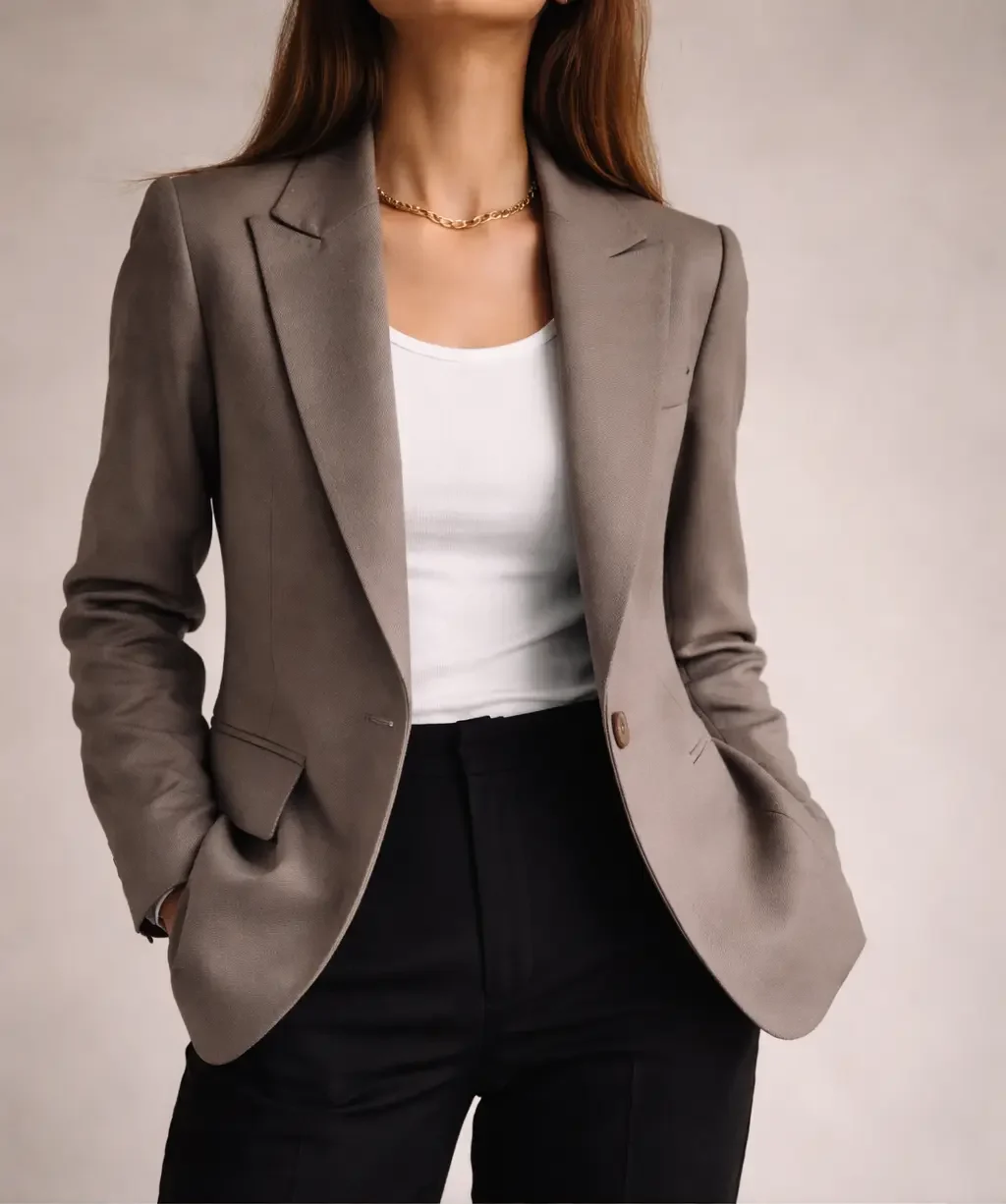
Quiet luxury wardrobe essentials are typically built around 10–15 key pieces that work together effortlessly over time.
Most wardrobes don’t fail because they are missing pieces. They fail because too many pieces are working against each other.
Quiet luxury wardrobe essentials are often misunderstood as a fixed list — or as a smaller wardrobe entirely, often without fully understanding what quiet luxury actually means.
The difference is not quantity. It is selection.
A well-built wardrobe feels cohesive, considered, and quietly complete—not because it contains everything, but because it contains what matters most: pieces chosen for structure, ease, and the way they work together over time.
This is where most people begin to rethink what they actually need—and where a wardrobe starts to refine itself.
What are quiet luxury wardrobe essentials?
Quiet luxury wardrobe essentials are a small group of carefully chosen pieces that create structure, versatility, and a consistently refined look. Rather than following trends, these pieces are selected for how they work together—forming the foundation of a cohesive wardrobe.
Most quiet luxury wardrobes are built from five essential categories:
- Foundation pieces (clean, versatile basics)
- Structure (tailored elements that create shape)
- Soft tailoring (ease without losing polish)
- Anchors (reliable, repeatable outfit pieces)
- The refinement layer (texture, drape, and subtle detail)
What Are Quiet Luxury Wardrobe Essentials?
Essentials are often treated as a checklist — a set of wardrobe basics to acquire and move on from.
In practice, they define how a wardrobe functions — and how many pieces it truly needs.
Essentials are the pieces that anchor everything else.
They are the ones you return to without effort — the ones that make the rest of the wardrobe feel coherent.
This is where most people misstep.
They focus on adding before understanding how to build a wardrobe that works as a whole.
Quiet luxury wardrobe essentials work best when they exist within a broader capsule wardrobe framework built around repetition, cohesion, and ease.
They create consistency across outfits, reduce friction in daily decisions, and allow the wardrobe to evolve without losing its shape.
To refine a wardrobe is not to reduce it blindly, but to understand which pieces carry the most weight — and why.
The 5 Essential Categories in a Quiet Luxury Wardrobe
Quiet luxury wardrobe essentials are not a list of items — they fall into a small number of functional categories.
Each category plays a distinct role, shaping how a wardrobe looks, feels, and works in practice.
Most quiet luxury wardrobes can be understood through five essential categories:
1. Foundation Pieces
These are the base of your wardrobe — clean, versatile pieces that work across multiple outfits. .
Think knitwear, trousers, and shirting.
They are simple by design, but essential for creating consistency and ease.
When foundation pieces are right, getting dressed becomes easier.
When they are not, everything feels slightly off.
This is where refined wardrobe basics matter most.
2. Structure
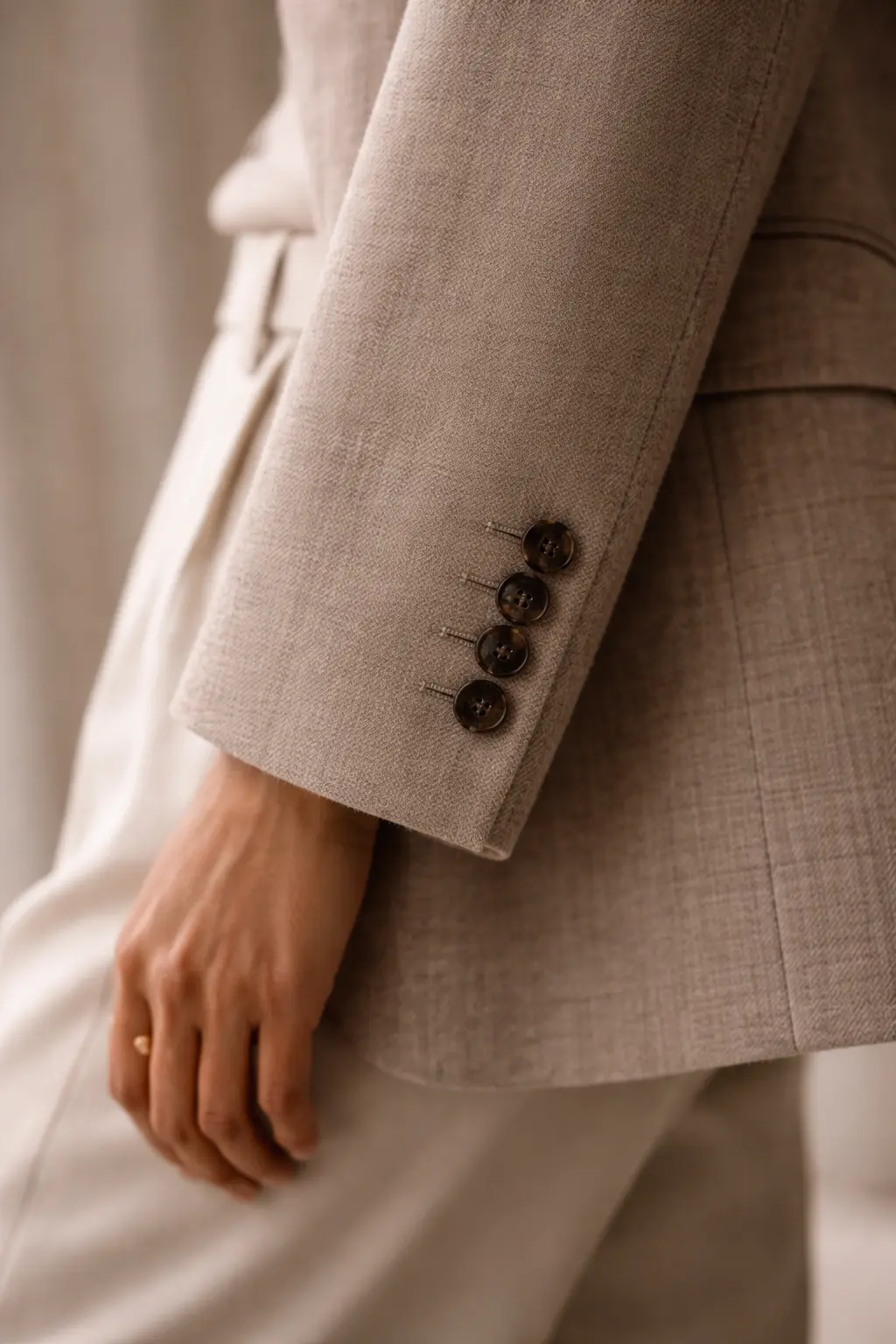
Structure is what creates clarity — particularly when learning how to dress with authority in a way that feels natural rather than forced.
Blazers, coats, and tailored layers give shape to an outfit and the wardrobe in general — defining proportion and anchoring the overall look.
The goal is not rigidity, but presence.
Pieces that hold their form without restricting movement.
This is often the first place to focus when learning how to build a wardrobe that feels polished.
3. Soft Tailoring
Without contrast, structure can feel severe. Soft tailoring introduces movement and ease without losing refinement.
These pieces allow the wardrobe to feel lived-in rather than constructed, balancing precision with comfort. They move with the body while still maintaining a polished silhouette.
They are essential for creating outfits that feel polished, but not stiff — a balance that often comes down to how fabric and movement work together.
4. Anchors
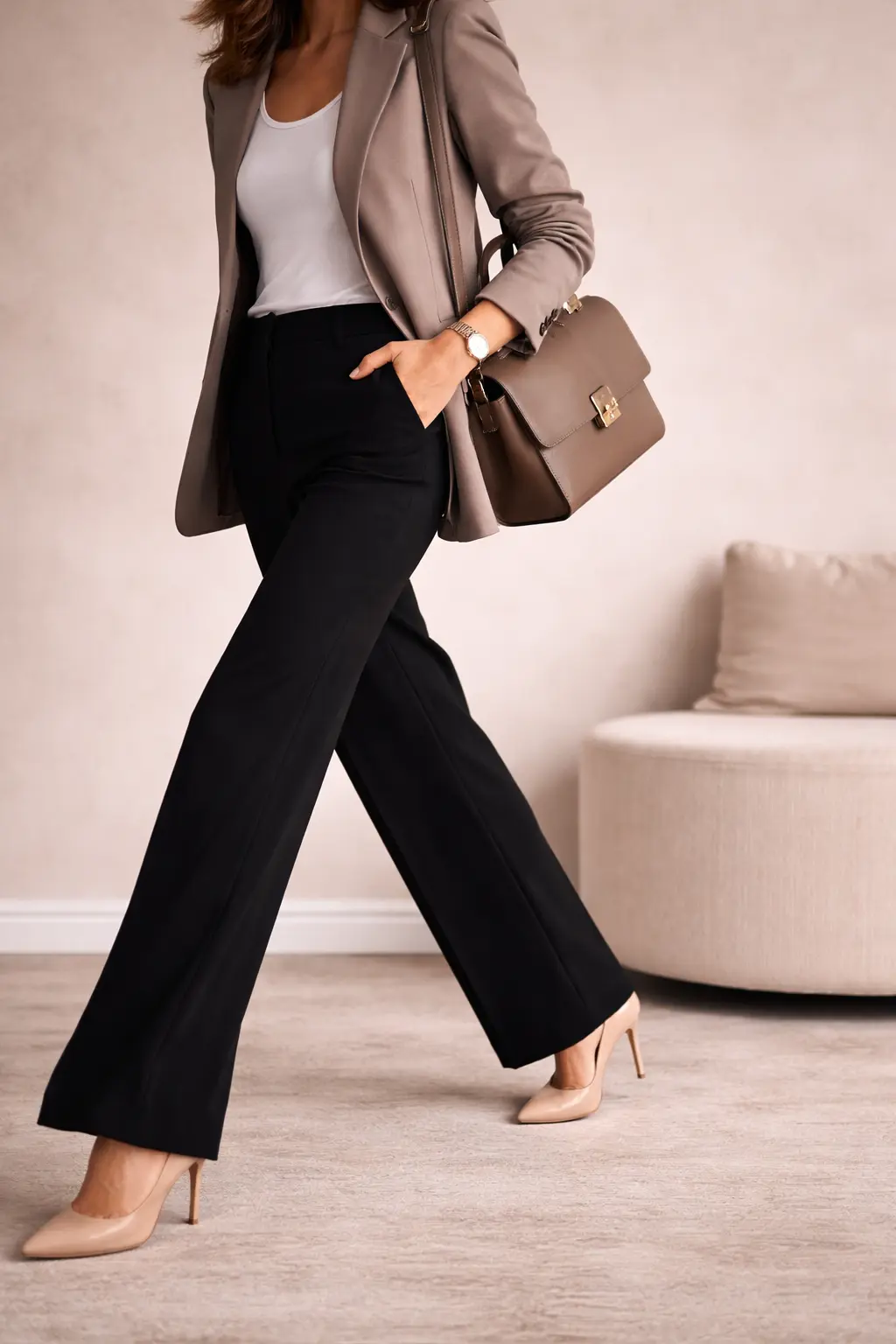
Anchors are often overlooked, but they quietly determine whether an outfit feels complete. These are the pieces you return to repeatedly.
Shoes, belts, and bags ground the look — connecting everything else and making outfits feel familiar, reliable, and cohesive.
A well-chosen pair of shoes can elevate even the simplest combination.
The wrong one can disrupt it entirely.
5. The Refinement Layer
This is where quiet luxury becomes visible.
This layer includes the elements that soften, elevate, or finish an outfit — subtle additions that shift how everything reads — often the subtle signals of quiet luxury that are easy to overlook, but immediately felt.
Fabric drape, and subtle detail elevate otherwise simple pieces into something considered and complete.
A Simple Quiet Luxury Wardrobe Essentials List
If you prefer something more concrete, this is what quiet luxury wardrobe essentials look like in practice.
Not as a checklist — but as a simplified view of how a refined wardrobe begins to take shape.
- A structured layer (often a blazer)
- A tailored trouser or skirt
- A clean, versatile top (shirt or knit)
- A foundational knit or layering piece
- A simple, well-cut dress
- A refined outer layer (coat or jacket)
- A polished everyday shoe
- A second shoe for variation (flat, loafer, or heel)
- A structured bag
- A subtle accessory (belt, watch, or jewelry)
This is where most wardrobes begin to shift.
Not by adding everything at once — but by understanding how the pieces connect, repeat, and build over time.
What matters is not the list itself, but how it translates into something you can rely on — daily, and without effort.
If you’d like to see what that can look like as a complete wardrobe, A 10-Piece Quiet Wardrobe: What I’d Build First offers one practical example of these principles in action.
The Quiet Luxury Essentials Edit
Eight pieces that put the principles into practice—considered materials, versatile silhouettes, and enough distinction to make an everyday wardrobe feel intentional. These are examples, not requirements: the goal is to understand what earns a place, then choose the version that works for your life.

Blazer Elevated
Relaxed Tailored Blazer
Example: Theory — Etiennette Blazer
Sharper than knitwear, softer than armor—the layer that gives an ordinary base enough authority.
Shop this blazer
Trouser Elevated
Draped Trouser
Example: Aritzia — New Agency Pant
A trouser that creates a long, controlled line without feeling rigid.
Shop these trousers
Shirt Elevated
Fluid Silk Shirt
Example: Vince — Stretch-Silk Button-Front Blouse
Softness and movement keep tailoring from becoming too severe.
Shop this shirt
Knit Elevated
Fine-Gauge Knit
Example: COS — Merino Wool Crew
Authority without stiffness—a clean neckline and enough drape to sit easily with tailoring.
Shop this knit
Dress Elevated
Column Dress
Example: Toteme — Everyday Column Dress
One clean line when the easiest answer needs to be the polished one.
Shop this dress
Outer layer Elevated
Three-Season Trench
Example: Aritzia — Finch Trench Coat
The layer that earns its place across changing weather without making the outfit feel overly practical.
Shop this trench
Bag Investment
Everyday Leather Tote
Example: DeMellier — The New York
The familiar everyday tote, softened and reshaped just enough to feel distinctive.
Shop this tote
Shoe Elevated
Refined Slingback
Example: Joan Oloff — Daphne Slingback
A feminine counterpoint to tailoring that moves easily from office hours to dinner.
Shop these slingbacksThis mini edit includes affiliate links. If you choose to purchase through them, The Quiet Luxe Edit may earn a small commission at no additional cost to you.
What Most People Get Wrong About Quiet Luxury Wardrobe Essentials
Most people approach quiet luxury wardrobe essentials as a list to complete. But the problem isn’t what’s missing — it’s how the pieces are being chosen.
A wardrobe built around 10-15 pieces should feel cohesive. When it doesn’t, the issue is rarely the number — it’s that the pieces are working in different directions.
This is often where the instinct to rebuild begins.
Most wardrobe problems are not caused by a lack of pieces — but by a lack of clarity.
Adding Before Editing
The instinct is to add more pieces in order to “complete” a wardrobe.
But without removing what doesn’t work, new pieces only create more noise.
A refined wardrobe is built by editing first—then adding with intention.
Choosing Trend Over Structure
Trend-led pieces often feel right in the moment, but they rarely integrate well.
Without structure, a wardrobe loses clarity.
Essentials should anchor your wardrobe, not compete for attention.
Confusing Minimal with Refined
Minimal is often interpreted as owning fewer pieces.
But refinement is not about reduction—it’s about selection.
A wardrobe can sit within the 10-15 piece range and still feel unresolved if the pieces don’t work together.
Trying to Fix Everything at Once
Most wardrobes don’t need a complete overhaul.
They need one or two thoughtful adjustments.
Progress happens gradually—through better choices, not more choices.
One piece that fits better.
One fabric that drapes differently.
One choice that aligns more closely with how you want to feel.
This is where the idea of essentials begins to shift — from a list of items to a way of building a wardrobe.

Where to Start with Quiet Luxury Wardrobe Essentials
If your wardrobe feels inconsistent or unfinished, the goal is not to replace everything.
Start with a few quiet luxury wardrobe essentials that improve how everything else works.
1. A Structured Piece
This is often the fastest shift.
Begin with one piece that introduces shape and presence:
- a blazer
- a structured coat
- a tailored layer that defines your silhouette
Structure creates clarity. Even simple outfits begin to feel intentional.
2. A Reliable Foundation Piece
Next, choose a piece you can wear repeatedly without effort:
- a well-cut trouser
- a refined knit
- a dress that works across settings
This is where consistency begins—one piece you reach for without thinking.
3. An Anchor
Finally, add one piece that grounds your wardrobe visually:
- a leather bag
- a pair of shoes
- a tonal layer that ties outfits together
Anchors create cohesion. They make different pieces feel like they belong.
If you’re building from scratch, the next step is understanding how these pieces come together as a system. Here’s how to build a quiet luxury wardrobe in practice.
How to Build From There
Once these are in place, the next steps become clearer.
You’re not adding randomly—you’re building around what already works:
- repeating successful combinations
- refining fit and fabric
- removing what no longer aligns
A wardrobe evolves through small, deliberate changes.
If you prefer a more structured approach, explore the 12-Piece Capsule Wardrobe.
A Quieter Way to Build
A quiet luxury wardrobe is not built quickly.
It does not come together in a single purchase, or even a single season.
It evolves — gradually — through what is kept, what is refined, and what is no longer needed.
There is a shift that happens over time.
Fewer decisions feel uncertain.
Fewer pieces feel out of place.
The wardrobe begins to hold its shape — without constant adjustment.
This is not the result of having more.
It is the result of having what works.
A piece that fits without effort.
A fabric that moves the way it should.
A combination that feels consistent, even when repeated.
Over time, the wardrobe becomes less of a collection — and more of a system.
The Quiet Luxe Framework
The thinking behind this approach is explored more fully in The Quiet Luxe Framework—a quiet reference for refining what you keep, what you repeat, and what belongs.
Explore the FrameworkQuiet Luxury Wardrobe FAQs
How many pieces should be in a quiet luxury wardrobe?
There is no fixed number, but most well-functioning wardrobes are built on fewer pieces than expected. The goal is not reduction for its own sake, but balance: enough pieces to create variation without creating friction.
If you’d prefer a more structured starting point, a 12-piece capsule wardrobe offers a practical framework.
What should I buy first when building a quiet luxury wardrobe?
Start with the pieces that influence everything else: one structured layer, one reliable foundation piece, and one anchor—usually shoes. These create immediate stability and make future decisions easier.
What makes an outfit look polished without feeling stiff?
The difference often comes down to how structure and movement interact. Fabrics that drape, pieces that allow ease, and clean proportions create polish without rigidity. The result feels natural rather than forced.
How do I rebuild my wardrobe without starting over?
Begin by editing rather than replacing. Remove what no longer aligns, then strengthen the few pieces that carry the most weight. A wardrobe evolves through adjustment, not complete reset.
What are the most important wardrobe essentials?
The most important essentials are the ones you repeat easily: foundation pieces, structured layers, and well-chosen anchors. Together, they create consistency and allow the wardrobe to function as a whole.
The next layer is how the pieces work together.
A refined wardrobe begins to feel easier before it begins to feel complete.
Once the right pieces begin to take shape, the next step is to build with intention—not by adding more, but by choosing what actually improves how your wardrobe works.
If you’ve been thinking about what to keep, what to add, and where to begin,
this is where most wardrobes start to shift.

