There’s a point where the question shifts from how to build a quiet luxury wardrobe to what actually defines one. (If you’re starting from scratch, this walks through the full process.)
Most guides will give you pieces.
Fewer explain why they work—and why others don’t.
A quiet luxury wardrobe isn’t defined by specific items, but by how those items function together without visual noise.
And still, certain categories appear again and again.
Not because they’re required—but because they hold the structure in place.
What pieces define a quiet luxury wardrobe?
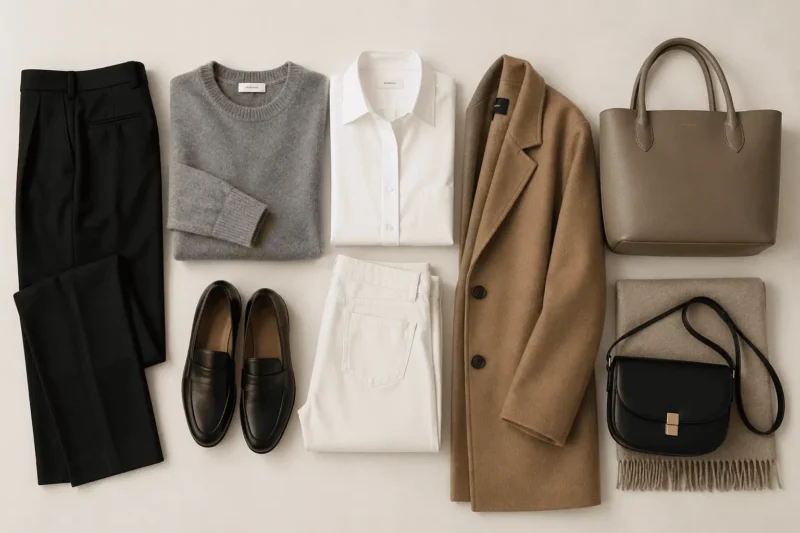
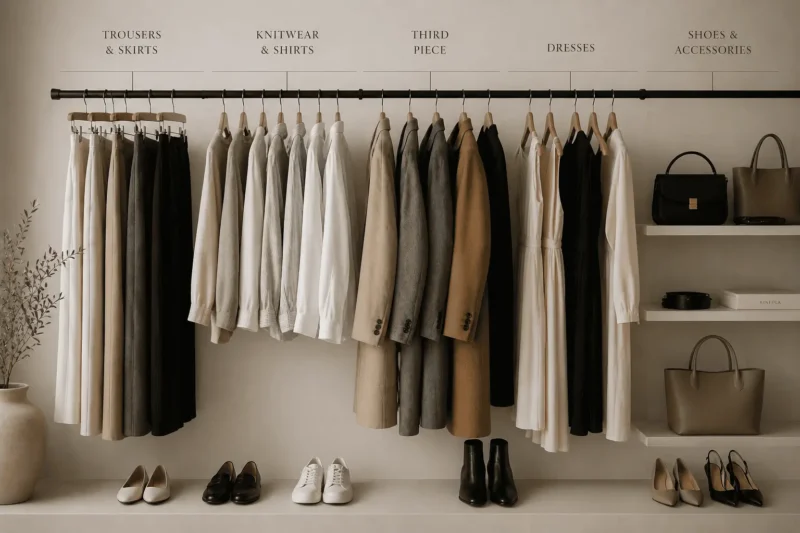
A quiet luxury wardrobe is defined by versatile, well-constructed pieces that work across multiple contexts. These often include tailored trousers, refined knitwear, structured outerwear, simple dresses, polished shoes, and understated accessories—chosen for silhouette, material, and repeatability rather than trend.
Most quiet luxury wardrobes naturally settle into 10–15 pieces per season, not as a rule, but as a result of clarity.
The pieces that usually define a quiet luxury wardrobe include:
- Tailored trousers or skirts — pieces that create structure and repeat easily
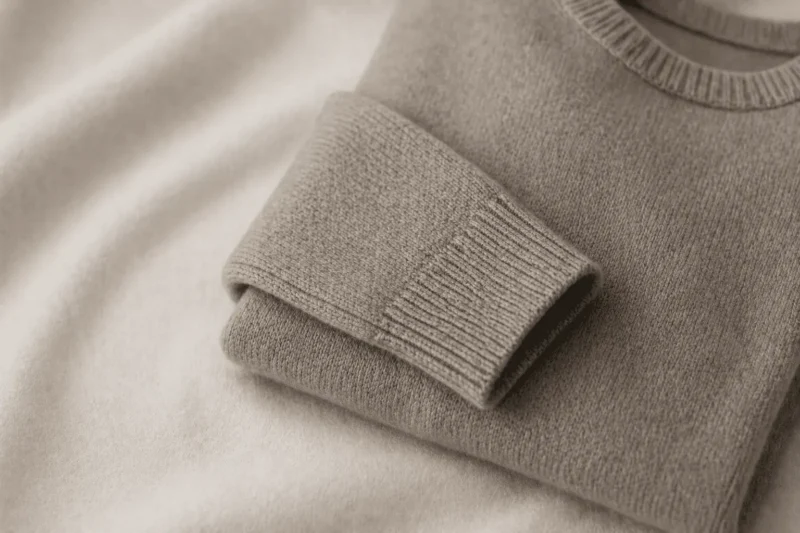
- Refined knitwear and shirts — layers chosen for texture, fit, and daily wear
- A reliable third piece — a blazer, coat, jacket, or cardigan that finishes outfits
- Simple dresses — clean silhouettes that adapt across settings
- Polished shoes — quiet anchors that support multiple outfits
- Understated accessories — bags, belts, jewelry, or watches that add cohesion without noise
The Critical Transition
A quiet luxury wardrobe isn’t defined solely by owning all of these.
It’s defined by how the wardrobe behaves.
A trouser is a trouser, a coat is a coat—but the difference lies in whether each piece can hold its place across multiple outfits without needing to be reworked.
That’s what gives the wardrobe its sense of calm.
And over time, a few categories begin to carry most of that weight.
The Pieces That Carry the Most Weight
The pieces that carry the most weight are rarely the loudest ones.
More often, they become the quiet luxury wardrobe essentials that anchor everything else through texture, proportion, and repeatability.
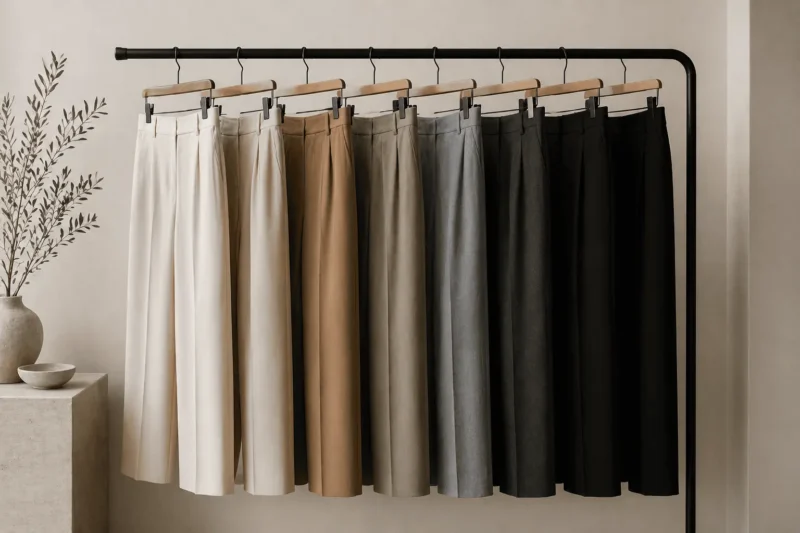
Trousers and Skirts (The Foundation)
These are the pieces a wardrobe rests on.
Not because they’re more important—but because they’re worn more often, and across more contexts.
A well-cut trouser or skirt creates a consistent line.
It anchors proportion—and determines how everything above it reads.
In a quiet luxury wardrobe, these pieces:
- hold their shape throughout the day
- work with multiple tops and layers
- feel appropriate across more than one setting
This is also where many wardrobes quietly succeed or fail.
If the foundation is inconsistent, everything built on top of it requires adjustment.
If you’re unsure how many foundation pieces you actually need, this breaks it down further.
Knitwear and Shirts (The Layer)
These are the pieces that sit closest to you—and often the ones you reach for most.
Because they’re worn frequently, their impact is cumulative.
A knit that holds its structure, a shirt that sits cleanly at the shoulder, a fabric that feels right from morning to evening—these details are subtle, but they shape the entire outfit.
Over time, these layers become less about variety and more about reliability.
You reach for them without reconsidering.
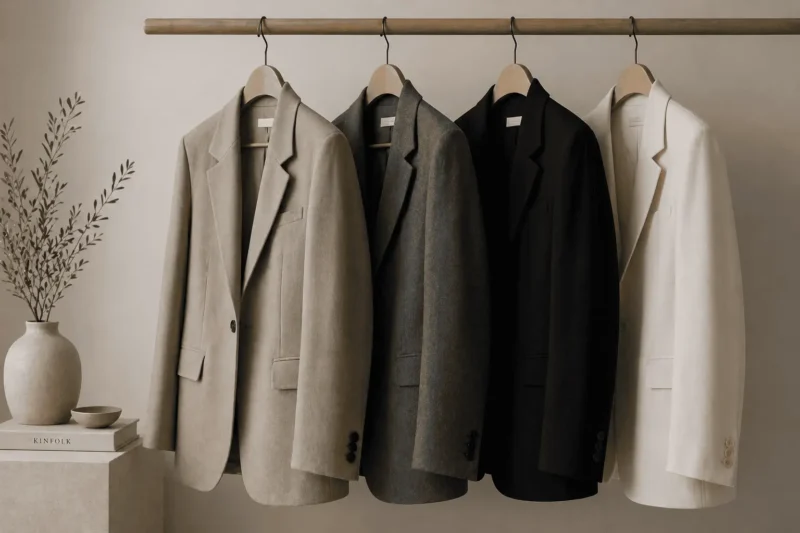
The Third Piece (Structure Without Effort)
This is the most defining category—where many capsule wardrobes begin to take shape.
A blazer, coat, jacket, or structured cardigan can shift an outfit instantly—not by adding complexity, but by adding clarity.
It gives the look a finished edge.
In many quiet luxury wardrobes, the third piece is what allows the rest to stay simple:
- a straight trouser + knit becomes complete with a coat
- denim + tee becomes intentional with a jacket
You don’t need many.
You need one or two that consistently resolve the rest.
Dresses (Simplified Form)
Dresses in a quiet luxury wardrobe tend to be uncomplicated.
Not because they lack interest—but because they don’t require adjustment.
A column dress, a shirt dress—something that follows the body without competing with it.
These pieces are useful because they reduce decisions:
- one piece instead of two
- one silhouette instead of several
They adapt with small changes—shoes, layers, jewelry—rather than needing to be replaced.
That’s what makes them useful over time.
Shoes and Accessories (Quiet Anchors)
These are often the least considered—but they carry more weight than they appear to.
A single pair of shoes or a well-chosen bag can either stabilize an outfit—or leave it feeling unresolved.
In a quiet luxury wardrobe, these pieces:
- repeat across multiple outfits
- sit comfortably within your palette
- feel consistent rather than interchangeable
They don’t draw attention—but they prevent distraction.
Over time, they become part of the wardrobe’s rhythm.
You reach for the same pair of shoes, the same bag, the same small details—because they continue to work.
What Makes These Pieces “Quiet Luxury”
It’s Not the Piece—It’s the Behavior
None of these categories are exclusive.
Most wardrobes contain some version of them.
What makes them feel different isn’t the piece itself—but how it functions within the whole.
A quiet luxury wardrobe works because its pieces don’t compete.
They align—creating a wardrobe that feels calm, coherent, and largely noise-free.
Silhouette
Silhouette is what allows a piece to hold its place.
Clear, consistent lines make outfits easier to build—and easier to repeat. When silhouettes align, pieces begin to work together without adjustment.
Palette
Palette reduces decision-making.
When colors sit comfortably together, most combinations work without effort. Nothing needs to be forced, and nothing feels out of place.
Material
Material determines how a piece wears over time.
Fabrics that hold weight, maintain shape, and feel right against the skin allows garments to be worn often without losing their presence.
Repeatability
Once the foundational pieces are in place, the wardrobe becomes less about endless variety and more about reliable combinations that can repeat naturally throughout the week, as shown in these quiet luxury outfit formulas.
A piece that can be worn often—across different settings—without feeling tired is what ultimately defines a quiet luxury wardrobe.
This is why similar wardrobes can feel completely different.
What You Don’t Need
A quiet luxury wardrobe isn’t built by adding more categories.
It’s clarified by removing what doesn’t support the whole:
- Pieces that only work in one specific outfit
- Variations that serve the same purpose without adding value
- Items chosen for the moment, rather than for repeated use
What’s left feels more stable—and easier to wear.
What It Feels Like
A quiet luxury wardrobe isn’t defined by having the right pieces.
It’s defined by having pieces that continue to work—quietly, consistently, and without effort.
You don’t notice the shift all at once.
It shows up in smaller ways first—reaching for the same pieces without hesitation, getting dressed without second-guessing, realizing that most of what you own already works together.
The noise fades.
There’s less adjusting, less explaining, less of that low-level friction that used to sit in the background of your mornings. The clothes do what they’re meant to do, then get out of the way.
What’s left is a kind of quiet reliability.
A wardrobe that holds its shape, supports your life, and asks very little of you in return.
Not perfect. Not finished.
Just considered enough that you can stop thinking about it—and move on to everything else.
Refining what these pieces become
Once you understand which pieces carry the most weight, the next step is learning how they work together—how many you actually need, how to simplify them, and how to build around them without overcomplicating the whole.
These next pieces explore that structure more directly—so your wardrobe begins to feel not just defined, but complete.

