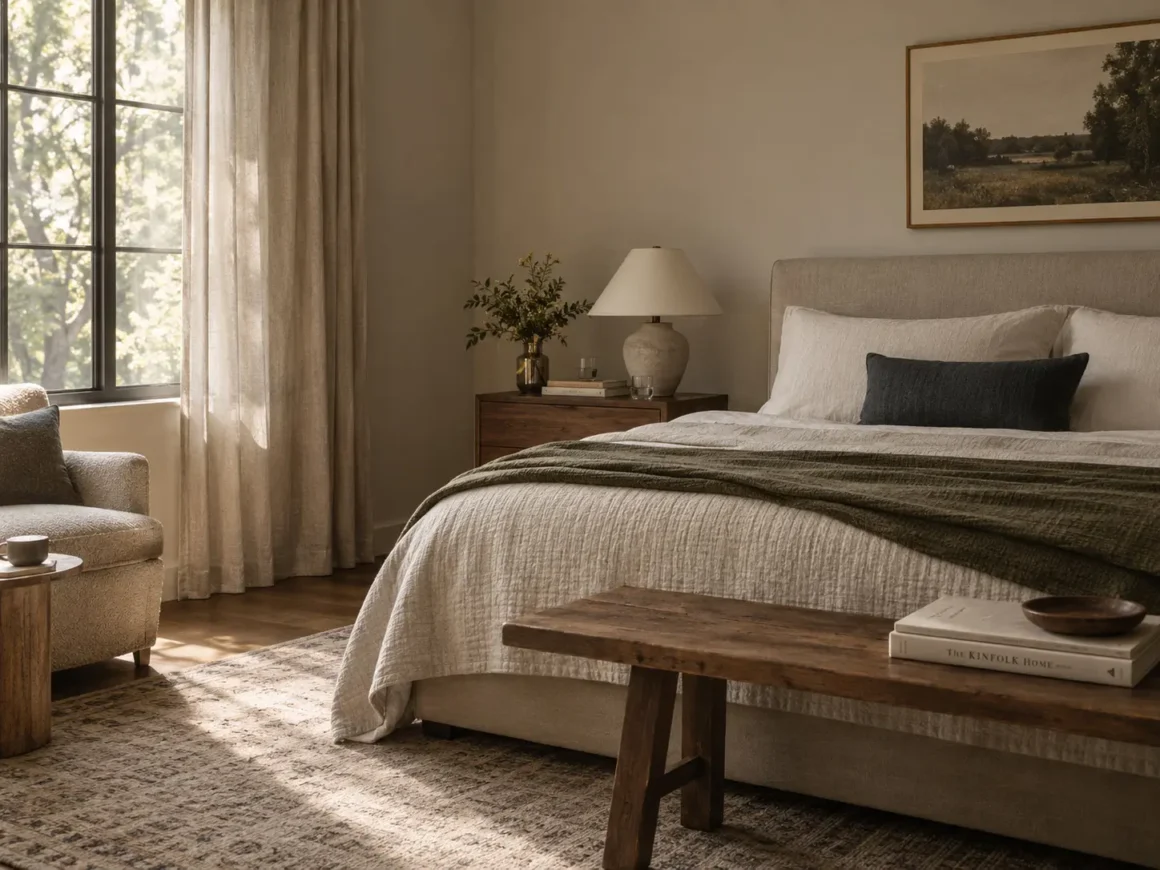
A calm bedroom is not necessarily a sparse one.
Learning how to create a calm bedroom has less to do with stripping the room back and more to do with reducing what the room asks you to process. An empty nightstand, white walls, or a bed stripped of everything except two perfectly placed pillows will not automatically make a space feel restful. In fact, rooms that are too visually controlled can feel just as restless as rooms with too much in them.
A bedroom feels calm when the eye can move through it easily. Colors relate to one another. Materials repeat. The lighting is soft enough to lower the volume. Objects have enough space around them to feel intentional rather than crowded.
And yet the room still needs warmth.
A bedroom without texture, variation, or signs of life may look peaceful in a photograph and still feel strangely flat in person. The goal is not to remove every point of interest.
It is to create quiet visual depth.
That balance between restraint and warmth is one of the central ideas behind Quiet Luxury at Home.
That means letting linen wrinkle. Allowing wood grain to show. Mixing smooth cotton with nubby wool. Using a darker tone to ground a pale room. Leaving a book on the nightstand because you are actually reading it.
A calm bedroom should feel edited.
Not erased.
And that distinction matters, because calm and minimalism are not quiet the same thing.
A Calm Bedroom Is Not an Empty Bedroom
What matters more than minimalism is visual hierarchy: deciding which elements should carry the room and allowing everything else to support them.
In most bedrooms, the bed naturally does much of that work. A well-made bed with beautiful fabric and enough texture may provide most of the softness the room needs. A substantial lamp can have more presence than several small accessories; one larger piece of art can create more ease than a collection of smaller ones.
When everything becomes a focal point, nothing gives the eye a place to rest. Calm comes from allowing some elements to speak and letting others remain quiet.
Begin With a Restrained Color Palette
A calm bedroom does not need to be monochromatic.
In fact, rooms built around a single shade can sometimes feel flatter than rooms that use several closely related tones. The goal is not to remove color. It is to reduce the amount of visual negotiation happening between colors.
A restrained palette gives the room a framework.
That might mean warm white, stone, camel, and soft brown. Or ivory, muted blue, charcoal, and walnut. Or pale taupe, cream, olive, and black.
The specific colors matter less than the relationship between them.
Choose a small group of tones that feel comfortable together, then repeat them throughout the room rather than introducing a new color with every edition. A warm wood nightstand might echo the brown in a leather tray; a muted blue pillow might pick up a tone in the artwork.
Nothing needs to match exactly.
Slight variation is usually what keeps a restrained palette from feeling overly decorated. Several shades of cream, for example, often feel richer than one identical cream repeated everywhere.
This is also where undertones matter.
A cool white beside a very warm beige can feel unexpectedly harsh. A yellow-toned cream may fight with a blue-gray wall. When a room feels “off” despite using neutral colors, competing undertones are often part of the problem.
Look at the colors together in the actual room, especially in both natural and evening light. The same taupe that feels quiet during the day may turn noticeably pink at night.
A restrained palette still benefits from contrast.
A darker wood tone, deep navy, charcoal, blackened bronze, or rich brown can give the eye somewhere to land and keep a pale room from disappearing into beige.
The point is not drama.
It is enough variation to create depth.
Think of the palette as a set of boundaries rather than a rigid formula. Once those boundaries are established, choosing bedding, curtains, rugs, and accessories becomes easier because every new piece does not have to introduce a new idea.
It simply has to belong.
A calm room often feels cohesive because the colors are repeating a quiet conversation rather than starting a new one in every corner.
Layer Texture Before You Add Decor
Minimalism and calm can overlap, but they are not the same thing. What matters more is visual hierarchy: deciding which elements should carry the room and allowing everything else to support them.
In most bedrooms, the bed naturally does much of that work. A well-made bed with beautiful fabric and enough texture may provide most of the softness the room needs. A substantial lamp can have more presence than several small accessories; one larger piece of art can create more ease than a collection of smaller ones.
When everything becomes a focal point, nothing gives the eye a place to rest. Calm comes from allowing some elements to speak and letting others remain quiet.
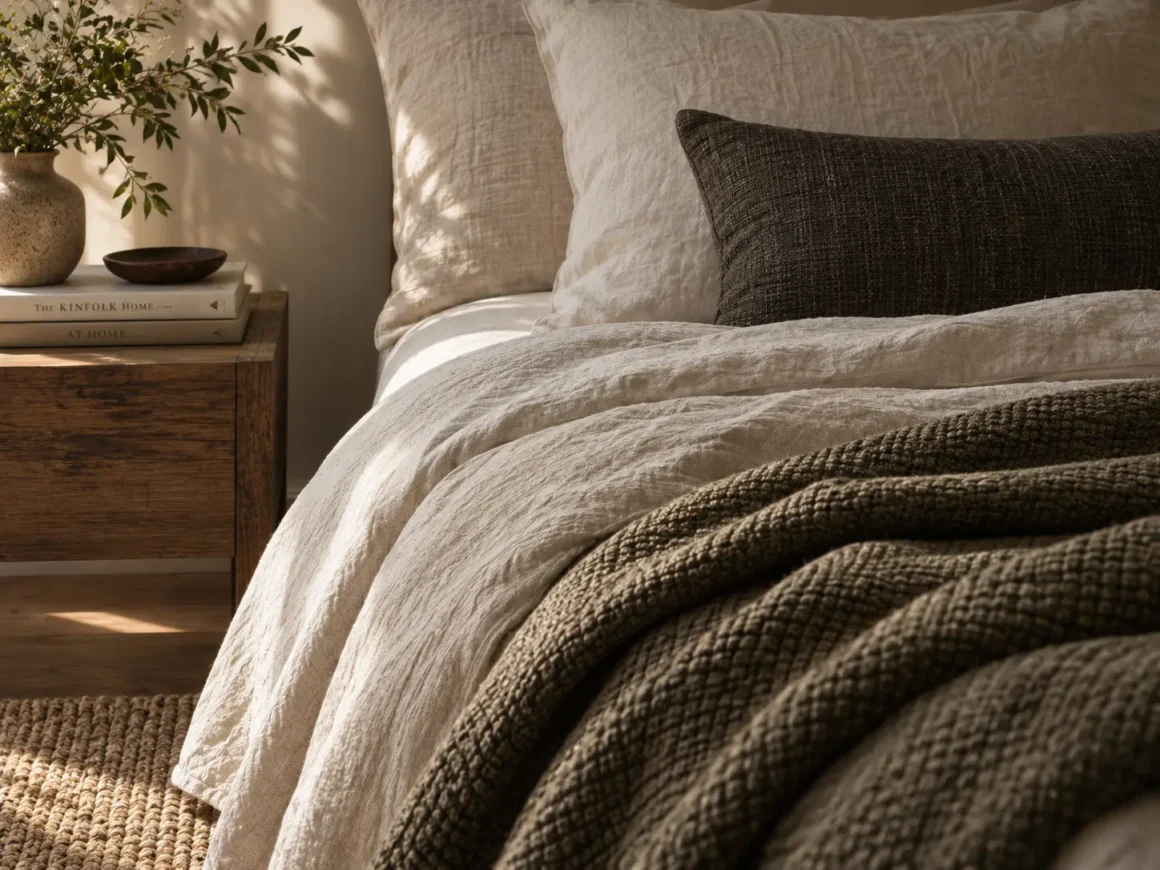
Once the color palette is quiet, texture is what keeps the room from feeling flat. The same principle applies throughout the home: texture can create depth without requiring more decoration.
A calm bedroom does not need more objects to feel layered. It needs materials that catch light differently, move differently, and create subtle contrast.
A linen duvet behaves differently from a crisp cotton sheet. Wool absorbs light in a way polished wood does not. A woven shade, leather tray, plaster lamp, or soft rug can all add depth without introducing another color or pattern.
Start with the largest surfaces.
Bedding, curtains, rugs, upholstery, and wood finishes will shape the room more than a collection of small accessories ever could. If those elements already have enough variation, the room may need very little decoration.
Think in contrasts:
Smooth against nubby. Crisp against soft. Matte against slightly reflective. Fine weave against visible grain.
The differences do not need to be dramatic. Subtle variation is often what makes a room feel layered rather than styled.
A crisp cotton sheet beneath a washed linen duvet may be enough. So might a smooth wood nightstand beside a woven basket, or a wool-covered bench against a quiet wall.
Texture needs hierarchy too.
If everything is plush, fuzzy, tufted, bouclé, velvet, and heavily layered, even a pale room can begin to feel visually dense. Let one or two materials be especially tactile, then balance them with cleaner surfaces.
Natural materials are particularly useful because they bring variation of their own. Wood grain, linen slubs, wool fibers, stone, leather, and woven materials rarely look completely uniform.
Those small irregularities help a room feel lived in rather than manufactured.
But the bedroom does not need to become a materials sample library. 😂
Choose a few textures and repeat them. If linen appears on the bed, perhaps it returns at the window. If warm wood anchors the nightstands, it might appear again in a frame or bench.
Repetition turns texture into cohesion.
And before adding another decorative object, consider whether the room simply needs a different material instead.
Sometimes a wool throw, woven shade, or warm wood surface will give the room more depth than several accessories could.
Texture lets a bedroom feel finished without making it busy.
That leaves the bed itself free to feel layered, inviting—and not overdressed.
Let the Bed Feel Finished, Not Overdressed
The bed is usually the visual center of the room.
That means it does not need much help.
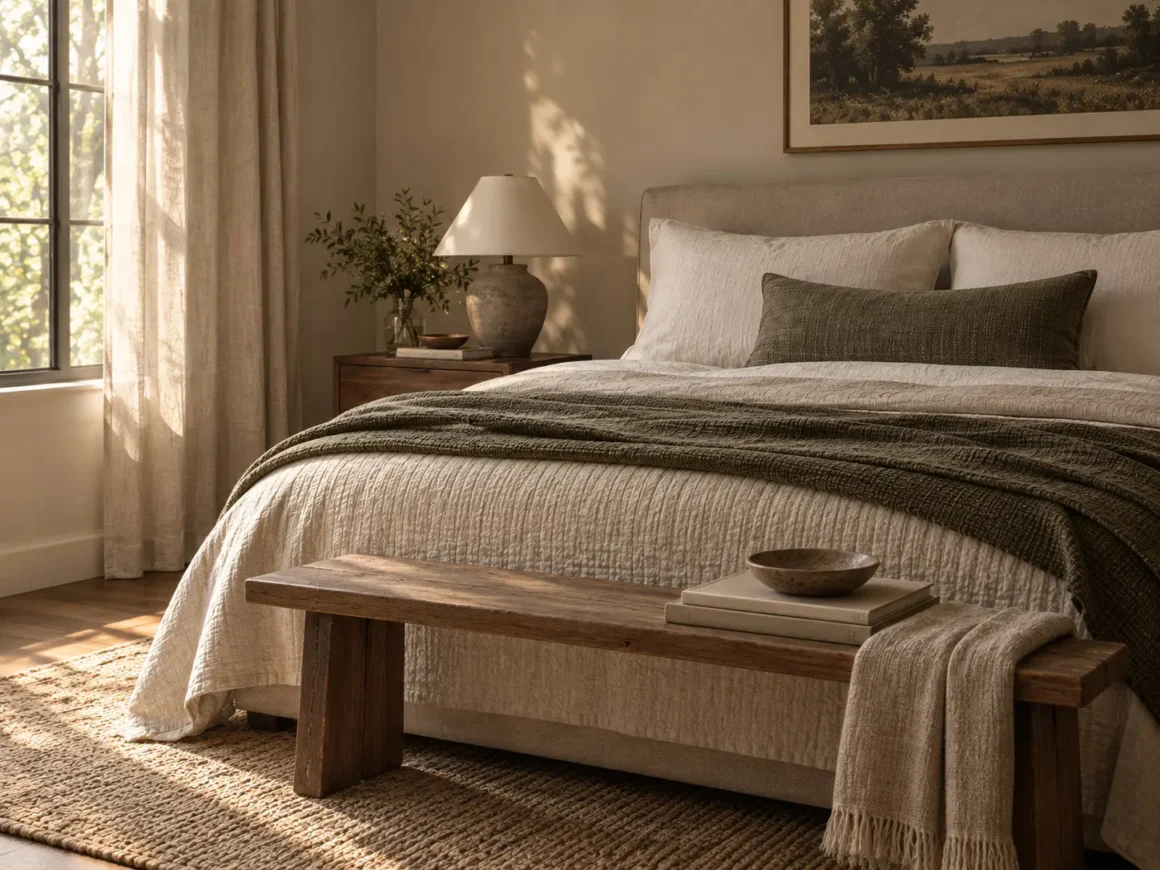
A beautifully made bed can carry much of the room’s atmosphere through proportion, texture, and color alone. When those elements are working, adding more pillows, throws, and decorative layers can make the room feel busier rather than more complete.
The goal is not abundance.
It is enough.
Start with the bedding itself.
Sheets, duvet or coverlet, and pillowcases should feel intentional together, even if they are not perfectly matched. A little tonal variation often makes the bed feel more relaxed and dimensional than a completely uniform set.
Then add one or two layers for depth.
That might be a folded quilt at the foot of the bed, a wool throw, or a linen coverlet beneath the duvet. The point is to introduce a different weight or texture without creating another thing to manage.
The same restraint applies to pillows.
A bed does not need to be rebuilt every morning with six decorative pillows arranged according to geometry. 😂 Two sleeping pillows per person may already create enough volume. Add a pair of shams or one long lumbar if the bed still feels unfinished, then stop.
The test is simple:
Does the bed look inviting, or does it look like work?
A bedroom should lower the amount of effort required at the end of the day. If the styling requires removing a mountain of cushions every night and reconstructing them every morning, it may be asking too much.
Scale matters too.
A king-size bed can support more visual weight than a smaller one. A low bed may benefit from cleaner layers, while a tall upholstered bed can handle a little more softness.
Let the fabrics do most of the work.
A rumpled linen duvet, crisp cotton sheets, and one textured throw can create more depth than several decorative objects. Their folds and shadows give the bed softness without adding clutter.
And allow a little imperfection.
The duvet does not need to be perfectly smooth. The throw does not need to sit at a precise angle. A bedroom should feel cared for, not staged within an inch of its life.
Finished is not the same thing as formal.
A finished bed simply looks considered enough that you are not tempted to keep adding to it.
Use Lighting to Lower the Volume
Lighting changes the emotional temperature of a bedroom faster than almost anything else.
A room can be beautifully furnished and still feel restless under one harsh overhead fixture. The same room, lit from a few lower sources, can feel quieter almost immediately.
The goal is not dimness.
It is layered light.
In a bedroom, layered lighting matters more than sheer brightness.
Start by thinking about where the light comes from, not just how bright the room is.
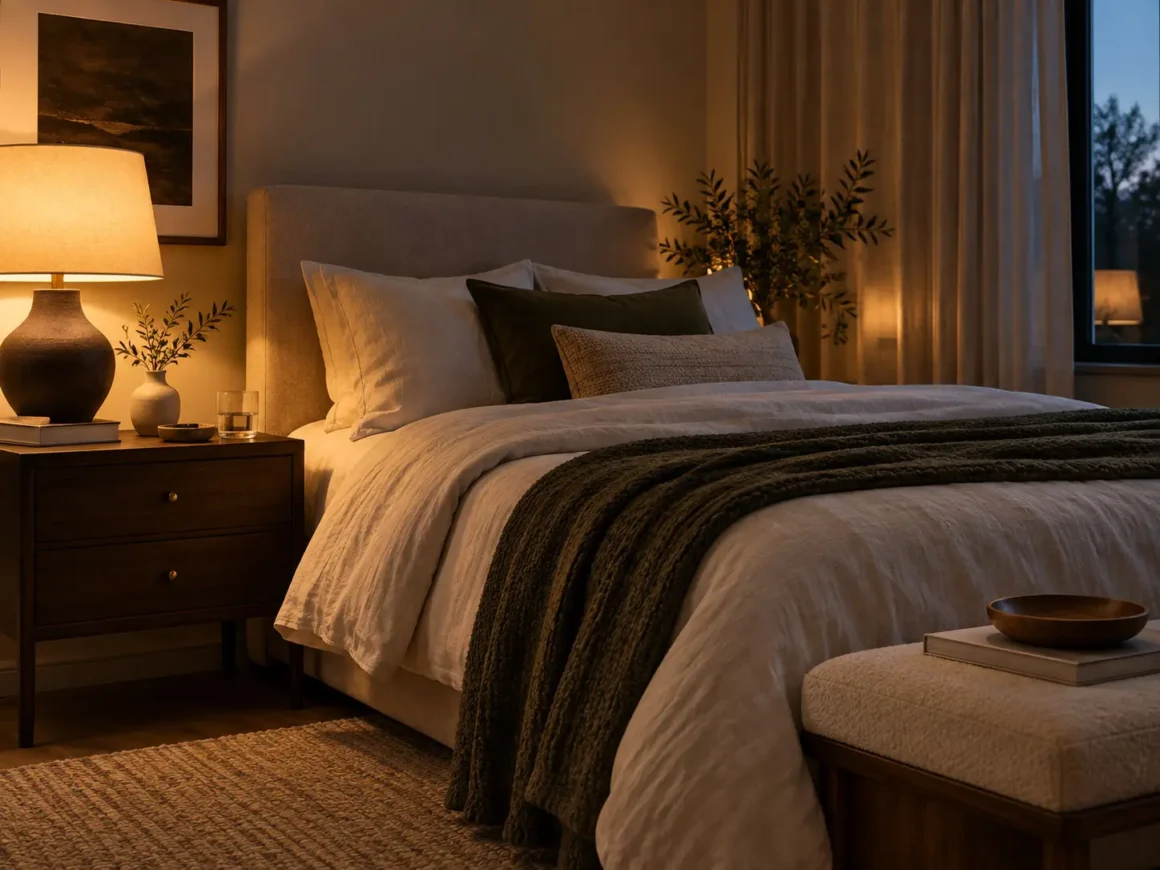
Bedside lamps, sconces, and other lower sources create pockets of light rather than flooding the entire room. That softer distribution makes the space feel more intimate and less exposed, especially in the evening.
The color of the light matters too.
Very cool bulbs can make a bedroom feel clinical, while warmer light tends to work more naturally with wood, linen, wool, and skin tones. It helps the room visually shift toward rest at the end of the day.
Dimmers make that shift easier.
The amount of light you need while getting dressed is not the amount you need while reading in bed or winding down at night. Being able to lower the intensity lets the room change with you.
Shades and diffusers matter as well.
Fabric shades, frosted glass, and indirect fixtures soften the edges of the light. Bare bulbs or highly exposed sources can work elsewhere, but in a bedroom they often ask for more attention than necessary.
Function still matters.
A beautiful lamp should still be easy to reach. A reading light should actually make reading comfortable. If the lighting creates inconvenience every night, it is not helping the room feel calm.
And as with everything else in the bedroom, restraint helps.
You do not need seven different lighting moments.
Often, one overhead source for general light, two bedside sources, and perhaps one additional lamp or sconce are enough.
A calm bedroom should not feel uniformly bright.
It should have gradations of light and shadow.
Lighting does not simply help you see the room.
It tells the room how loudly to speak.
Choose Furniture With Visual Weight and Breathing Room
Furniture sets the rhythm of a bedroom before you notice any of the smaller details.
A room can have beautiful bedding, thoughtful lighting, and a restrained palette, but if the furniture feels too small, too bulky, or poorly proportioned, the room can still feel unsettled.
The goal is not to fill every available wall.
It is to choose furniture with enough visual weight to ground the room, then stop before every gap becomes something to solve.
Visual weight is not the same thing as physical size.
A low, solid wood dresser may feel more substantial than a taller piece with thin legs. An upholstered bed can carry more presence than a simple metal frame. A sculptural nightstand may feel visually heavier than a larger table with an open base.
What matters is how much attention each piece asks for.
Start with the largest elements.
The bed usually establishes the scale, followed by the dresser, nightstands, and any chair or bench. These pieces do not need to match, but they should feel proportionate to one another.
A substantial bed paired with tiny nightstands can feel unbalanced. So can a delicate bed surrounded by oversized case goods.
The pieces simply need to feel as though they belong in the same room.
This matters especially in smaller bedrooms.
The instinct is often to choose several small pieces because they seem less imposing. But multiple undersized pieces can create more visual noise than one or two larger, better-proportioned ones.
Fewer pieces with stronger shapes often feel calmer.
A single chest with enough storage may work better than a dresser plus several small cabinets. One comfortable chair may contribute more than two decorative ones. A substantial nightstand with a drawer may be quieter than a delicate table surrounded by baskets.
Closed storage can help too.
Bedrooms naturally collect clothing, books, chargers, glasses, skincare, and all the small objects of daily life. Furniture that can quietly absorb some of that activity makes the room easier to live in.
But not every piece needs to be heavy or closed.
A room often feels more balanced when solid pieces are mixed with lighter forms—a nightstand on legs, an open bench, a simple chair—so the furniture does not all carry the same visual density.
And before adding another piece, ask whether the room actually needs it.
Sometimes an empty corner does not require a chair.
Sometimes a wall does not need a console.
Sometimes the most useful decision is to leave enough room for the furniture already there to do its job.
The room should feel grounded, not furnished to capacity.
Give the Eye Somewhere to Rest
A calm bedroom needs pauses.
Not every wall needs art. Not every surface needs an object. Not every corner needs to be resolved.
Visual rest comes from leaving enough quiet space around the things that matter.
That might mean a mostly clear nightstand with only a lamp, a book, and a small dish. It might mean one piece of art over the bed instead of several smaller ones. It might mean allowing a stretch of wall to remain completely empty.
Those pauses help the room feel composed rather than crowded.
They also give the objects you do keep more presence.
A sculptural lamp becomes more noticeable when it is not competing with several accessories. A vase feels more deliberate when it is not one of six objects on a dresser. A piece of art can anchor a wall when it has enough space around it.
This is part of why clutter can feel tiring even when every individual object is attractive.
The eye keeps moving.
It keeps deciding what deserves attention.
A calmer room reduces the number of things competing for that attention.
That does not mean stripping the room of personality. It means giving personality room to register.
Negative space is especially useful around visually strong elements.
If the bed already has substantial bedding and a strong headboard, the wall behind it may need very little. If a dresser has beautiful grain or a darker finish, the surface above it may benefit from one larger piece rather than several small ones.
The same principle applies to floors and surfaces.
A rug can soften the room beautifully, but it does not need to be surrounded by baskets, stools, ottomans, and small tables. A nightstand can be useful without becoming a display surface.
Think of empty space as part of the composition rather than the absence of one.
An unfilled area is not necessarily waiting for something.
Sometimes it is doing exactly what the room needs.
A bedroom should not keep your attention moving from one thing to the next.
It should let your attention settle.
Add Signs of Life, Not Clutter
A calm bedroom should still feel inhabited.
Without that, a room can drift from peaceful into anonymous.
The difference is often in the objects you allow to remain visible.
A book you are actually reading. A glass of water. A cardigan over the back of a chair. A small dish for jewelry. A vase with one branch or a few stems.
These are signs of life.
They make the room feel personal and warm without turning every surface into a display.
The key is that the objects have a relationship to how you actually live in the room.
Clutter often begins when we add things simply because a surface feels empty. A tray acquires a candle, then a box, then a vase, then a stack of books, until the surface is styled but no longer especially useful.
A calmer approach is to let function do some of the decorating.
If you read in bed, keep a book nearby. If you remove jewelry at night, give it a beautiful dish. The room does not need to hide every trace of you.
It simply needs enough restraint that those traces remain legible.
Personal objects can matter most here.
A photograph, a piece of art with meaning, or something brought home from a trip can give a room more character than several generic accessories chosen only to fill space.
You do not need many.
One meaningful object often has more presence than a collection of decorative ones.
Plants and flowers can add life too, but they should not become another layer of visual competition. A single branch, one small plant, or a simple vase may be enough.
The goal is not to make the room look untouched.
It is to make it feel lived in without feeling overrun.
Daily life will always leave a little evidence behind.
There will be a charger.
There may be a robe.
A book might stay open on the nightstand.
That is not a failure of the room.
A calm bedroom should have enough personality to feel like yours—and enough space that you can still live in it.
Edit Before You Shop
A bedroom can feel unfinished for reasons that have nothing to do with what it is missing.
Sometimes the problem is simply that too much is already competing for attention.
Before buying another lamp, pillow, basket, tray, or piece of furniture, edit the room first.
Clear the nightstands. Simplify the dresser. Remove the chair that has become a permanent landing zone. Then put back only what the room actually needs.
This is not about creating an empty bedroom.
It is about seeing the space clearly enough to understand the real gap.
Once the visual noise is reduced, you may discover that the room does not need another accessory at all. It may need better lighting. A larger piece of art. A warmer material. More useful storage.
Or it may simply need less.
That distinction matters because shopping is often used to solve a problem that is actually one of editing.
Before adding something new, look at function first.
Is there enough closed storage?
Can you reach what you need from bed?
Does the lighting work?
Can you move through the room easily?
Do the things you use most often have somewhere to go?
Those questions will usually lead to better purchases than asking what would make the bedroom look more finished.
And when you do identify something worth buying, be specific about the job it needs to do.
Not I need something for this wall.
I need one larger piece of art to balance the bed.
Not I need more storage.
I need a chest with enough drawers to remove clothing from sight.
Not The room feels cold.
I need a warmer material or a lower source of light.
Specific problems produce better decisions.
Vague dissatisfaction tends to produce more stuff. That pause between noticing dissatisfaction and buying something to fix it is often where the better decision happens.
A calm bedroom is rarely created in one shopping trip. It develops through small corrections: removing what distracts, noticing what remains, and adding only what makes the room work better.
Editing is not what happens after decorating.
It is part of decorating.
The Edit
Create a home that asks less of you.
Join The Edit for quiet guidance on creating rooms that feel calm, considered, and complete — without adding more.
The Bedroom Should Ask Less of You
A bedroom should make the end of the day easier.
That does not mean it has to be perfectly organized, beautifully styled, or free of every practical object. It means the room should support the way you actually move through it without creating unnecessary friction.
You should be able to reach the lamp.
Find the charger.
Set down a glass of water.
Put away clothes without rearranging three other things first.
Walk around the bed without navigating a maze of furniture.
The room should work quietly in the background.
That is what makes calm feel different from decoration.
A calm bedroom is not calm because every surface is empty or every object is expensive. It is calm because the room asks for fewer decisions.
The lighting is easy to adjust.
The bedding is comfortable and simple enough to manage.
The storage is where you need it.
The furniture leaves enough space to move.
The things you use most often have a place.
And the room does not require constant attention to keep looking presentable.
That last part matters.
If a bedroom only feels beautiful when everything is arranged precisely, hidden immediately, and reset every morning, the room may be working harder than you are.
A more forgiving room has some flexibility built into it.
The linen can wrinkle.
A book can stay on the nightstand.
The throw can shift.
The chair can hold a cardigan for the evening.
There is enough order that these small signs of life do not overwhelm the space.
And perhaps that is the best measure of whether the room is finished.
Not whether it photographs perfectly.
Not whether it follows a particular aesthetic.
Not whether there is anything left you could buy.
But whether, at the end of the day, the room lets you arrive without asking for anything else.

Where This Leads
Continue exploring a quieter home.
A calm bedroom is one expression of a larger idea: rooms feel better when materials, light, and the things we choose to keep are working together rather than competing for attention.
