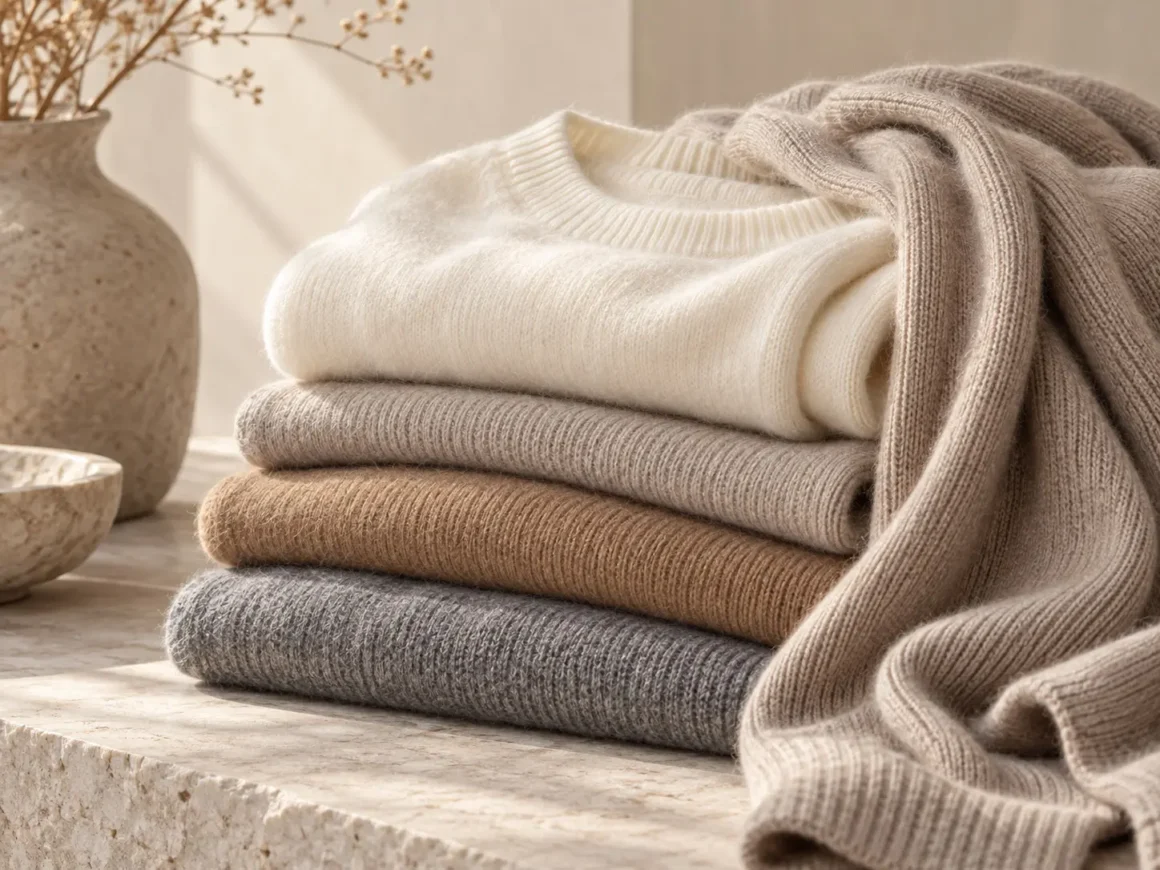
Cashmere has one of the strongest reputations of any fabric in a wardrobe.
The word itself has become shorthand for softness, luxury, and quality—which makes it surprisingly easy to assume that a sweater labeled 100% cashmere must be a good one.
It doesn’t work quite that way.
Cashmere is a fiber. Quality is a set of characteristics.
Two sweaters can both be made entirely from cashmere and feel very different after a season of wear. One may hold its shape, soften gradually, and develop only minor surface pilling. Another may begin shedding, fuzzing, and losing its structure almost immediately.
The difference begins with the fiber itself—especially its fineness and length—but it continues through the way that fiber is spun, knitted, finished, and ultimately made into a garment.
Fortunately, you do not need a microscope or a textile laboratory to make a better judgment before you buy.
You just need to know what the label can tell you, what your hands and eyes can tell you, and which familiar cashmere claims deserve a little more skepticism.
100% Cashmere Does Not Mean High-Quality Cashmere
Start with the label—but do not stop there.
In the United States, a garment labeled cashmere must meet a specific legal definition. The fiber must come from the fine, dehaired undercoat of a cashmere goat, and its average diameter cannot exceed 19 microns. A garment described as 100% cashmere must also accurately disclose that fiber content.
That tells you something important: the sweater is actually cashmere.
It does not tell you whether it is particularly fine cashmere, whether the fibers are long enough to make a strong yarn, whether the knit is dense and resilient, or whether the sweater was constructed to hold its shape through repeated wear.
Think of 100% cashmere as a statement of composition, not a quality grade.
The useful question is not simply Is this cashmere?
It is:
What kind of cashmere is this—and how well has it been turned into a garment?
What Actually Determines Cashmere Quality?
Cashmere quality begins with the fiber itself.
Two characteristics matter especially: fineness and length. Fine fibers contribute to the softness cashmere is known for, while longer fibers can be spun into stronger, more stable yarns that are generally less prone to persistent pilling and better able to hold their shape. The Cashmere and Camel Hair Manufacturers Institute identifies fiber length and fineness among the most important determinants of cashmere quality.
Cashmere fibers typically fall between roughly 14 and 19 microns in diameter. A lower micron number means a finer fiber and, generally, a softer feel. But fineness alone is not enough. Very fine cashmere made from shorter fibers may feel wonderfully soft at first while shedding or pilling more readily with wear.
This is why softness can be useful information without being proof of quality.
Longer fibers give the yarn more continuity. There are fewer loose ends working their way toward the surface, which can help the garment remain smoother and more stable over time. Shorter fibers can still produce a soft sweater, but they are more likely to migrate out of the yarn and form pills.
Then there is what happens after the fiber becomes yarn.
How tightly and evenly the yarn is spun, how densely the garment is knitted, and how it is finished all affect the way the cashmere performs. A loosely knitted sweater may use genuine cashmere and still feel limp, lose its shape, or wear poorly. CCMI specifically notes that loose, limp knitting can be a sign of cheaper construction.
This is the same distinction that matters when judging fabric quality more broadly: fiber content tells you what something is made from; construction tells you much more about how it is likely to behave.
For the shopper, there is one complication: most of this information is invisible.
A label rarely tells you fiber length. Many brands do not publish micron measurements. And even useful details such as ply cannot tell you, by themselves, whether the finished sweater is good.
So the goal is not to become a cashmere grader standing in the fitting room.
It is to understand what creates quality—and then learn to recognize its effects.
A good cashmere sweater should feel soft, certainly. But it should also have substance, evenness, resilience, and enough structure to recover after you handle it.
Those qualities often tell you more than softness alone.
Do Not Mistake Extreme Softness for Quality
Softness matters in cashmere. It is part of what makes the fiber desirable in the first place.
But extreme softness at first touch is not proof of exceptional quality.
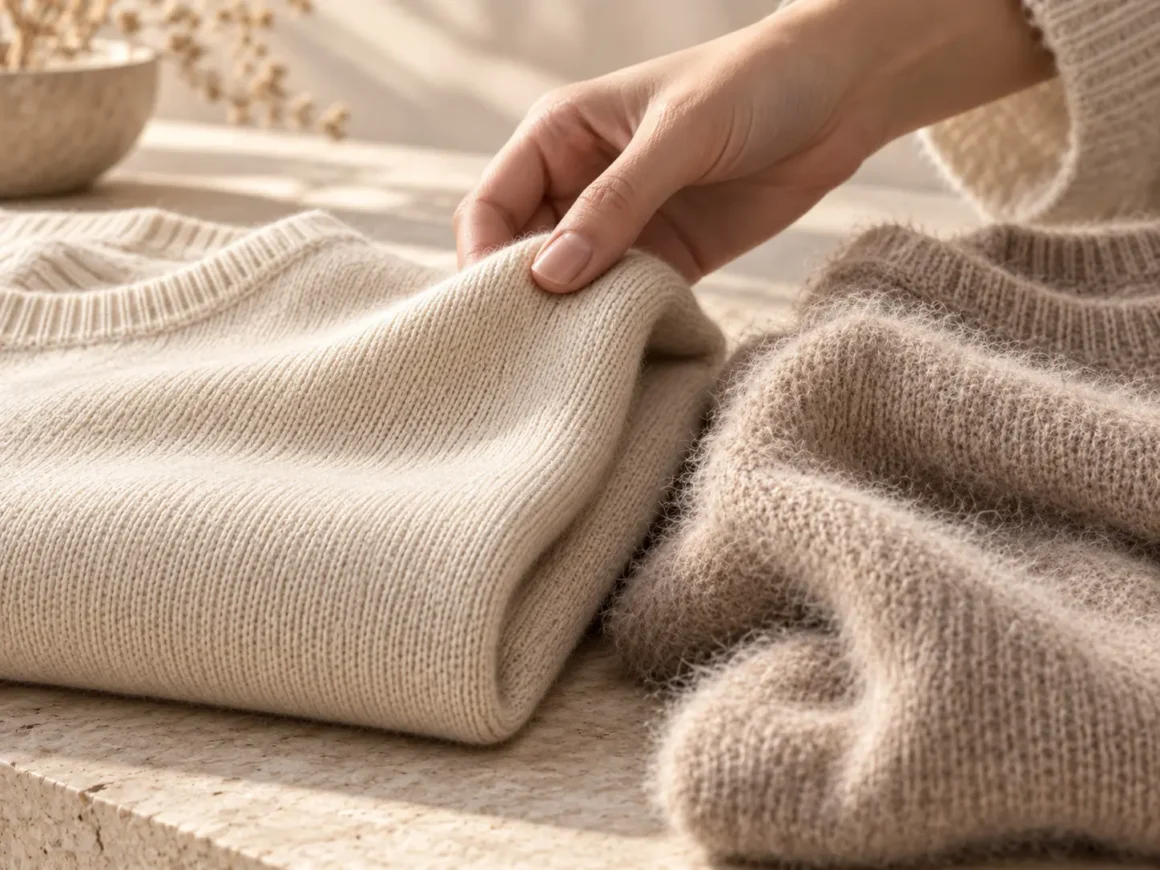
Some cashmere is brushed or finished to create a softer, fluffier surface before it reaches the store. That can make a sweater feel immediately luxurious, but it can also leave more loose fiber at the surface. A very fuzzy finish may be more prone to shedding or pilling with wear.
That does not mean a soft or slightly brushed sweater is automatically poor quality. Some excellent cashmere is intentionally finished for a softer hand.
It simply means softness should not be the only test.
A better cashmere sweater often feels soft and substantial. The surface should look relatively even rather than excessively hairy. The knit should have some body. And when you handle the garment, it should feel as though the softness belongs to the fiber itself—not as though the sweater has been aggressively fluffed to create an immediate impression.
This is also why pilling deserves some nuance.
Even high-quality cashmere can pill at first as loose fibers work their way to the surface, especially in areas of friction. Johnstons of Elgin describes early pilling as a natural stage in the life of cashmere, while longer, higher-quality fibers tend to be less prone to persistent pilling over time.
So the question is not:
Does this sweater feel incredibly soft?
It is:
Does it feel soft while still showing signs of substance, stability, and a well-made surface?
That distinction is much more useful.
Look at the Surface Before You Touch It
Before you test softness, look closely at the sweater.
Good cashmere does not need to look perfectly smooth. A slight halo is normal; cashmere is a fine animal fiber, not polished cotton. What you are looking for is a surface that feels even and controlled rather than excessively fuzzy or already worn.
Pay attention to three things.
The amount of loose fiber.
A sweater covered in a thick, fluffy haze can feel wonderfully soft, but that surface may also contain fibers that are more likely to shed or work themselves loose with wear.
The consistency of the knit.
Look across the body of the sweater rather than concentrating on one spot. The surface should appear reasonably uniform, without obvious thin patches, loose areas, or sections that look markedly different from the rest.
The areas most likely to show friction.
If you are buying secondhand—or examining a store sample that has been handled repeatedly—look at the underarms, sides, cuffs, and waistband. Those areas can reveal how the cashmere responds to rubbing far better than the untouched center of the sweater.
None of these signs should be treated as an automatic pass-or-fail test. A lightweight cashmere knit will naturally look different from a dense winter sweater, and a softly brushed finish may be an intentional design choice.
The useful question is whether the surface looks appropriate for the kind of garment it is trying to be.
A fine layering sweater can be light. A substantial crewneck can have more body. What you want to avoid is a sweater whose surface already seems unstable before you have even worn it.
Look first. Then touch.
That makes softness one piece of evidence rather than the entire verdict.
Check the Knit for Density and Recovery
Once you have looked at the surface, pay attention to how the knit behaves.
A good cashmere sweater should have enough density and resilience to feel intentional. That does not mean every sweater should be thick. A fine-gauge layering knit may be light and delicate, while a winter crewneck may feel considerably more substantial. The question is whether the construction suits the garment.
Start by holding the sweater up to the light.
You should expect some light to pass through a fine knit, but look for obvious unevenness, unusually open areas, or places where the fabric seems thin without a clear design reason. A sweater that feels soft but almost insubstantial may simply use less fiber or a looser knit.
Then test its recovery.
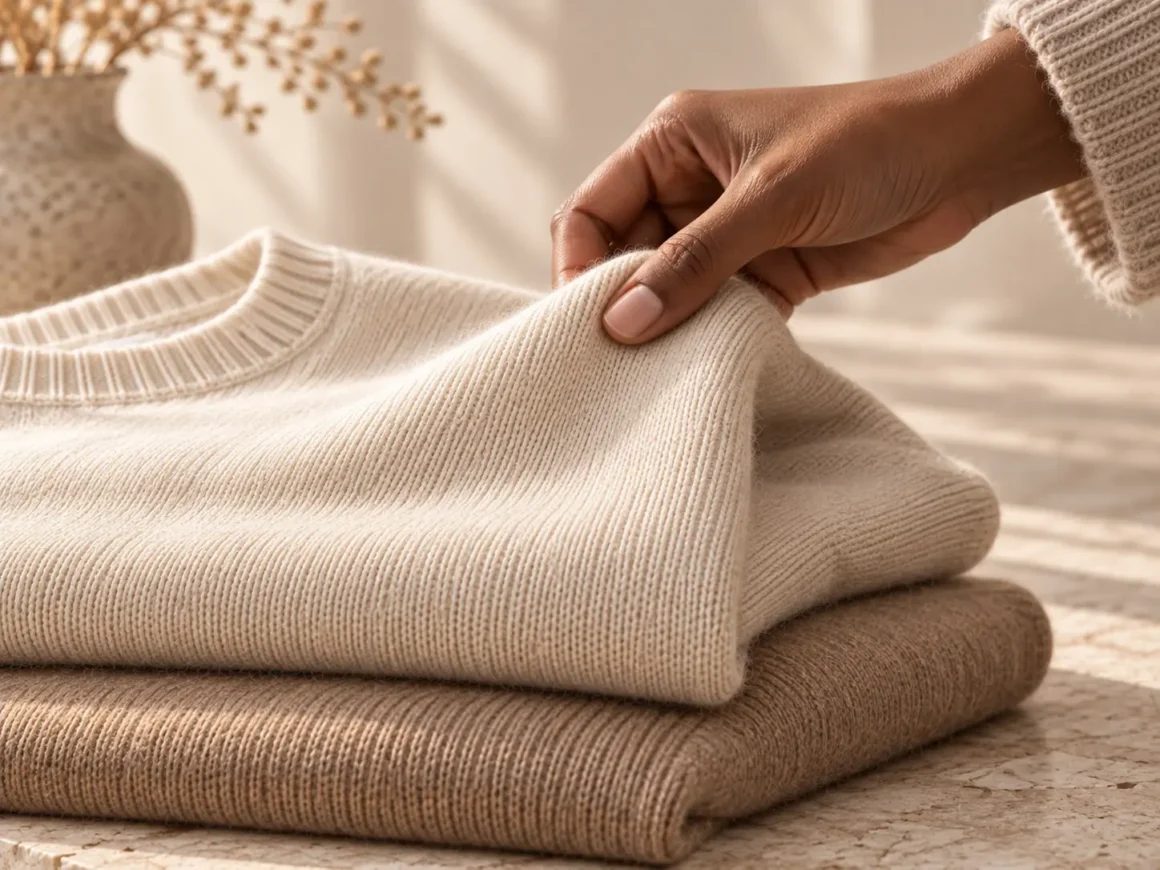
Gently stretch a small section of the fabric—at the body or hem rather than pulling aggressively at the neckline—and release it. The knit should return toward its original shape rather than remaining stretched or looking tired.
This matters because cashmere is meant to be worn repeatedly. A sweater may feel beautiful in your hands and still be disappointing if the cuffs bag, the elbows distort, or the body loses its shape after a few wears.
The Cashmere and Camel Hair Manufacturers Institute recommends looking for a knit that feels firm rather than loose and checking whether the fabric springs back after being stretched.
The simplest test is this:
Does the sweater feel light because it was designed to be light—or because there is simply not much there?
Weight alone does not determine quality.
Intentional construction does.
Understand Ply Without Treating It Like a Ranking System
Ply is one of those cashmere terms that sounds wonderfully definitive.
Two-ply must be better than one-ply. Four-ply must be better than two-ply. Six-ply must be practically aristocratic.
Not quite.
Ply simply tells you how many individual strands of yarn have been twisted together to create the yarn used in the garment.
A two-ply yarn combines two strands. Four-ply combines four. Adding plies can create a thicker, more substantial yarn and can improve stability compared with a very fine single strand.
But more plies do not automatically mean higher-quality cashmere.
A beautifully made two-ply sweater using long, fine fibers can be better cashmere than a heavier four-ply sweater made from shorter or less carefully processed fibers. Ply tells you something about the construction and weight of the yarn. It does not tell you everything about the quality of the fiber inside it.
This is why it helps to think about purpose rather than hierarchy.
A light two-ply knit may be exactly right under a blazer. A heavier multi-ply sweater may be better suited to cold weather or worn as an outer layer. Neither is inherently superior simply because one uses more yarn.
So when a brand prominently advertises “4-ply cashmere,” take it as useful information—but not a verdict.
Ply tells you how the yarn is built. It does not give the sweater a quality score.
What to Look for When Shopping Cashmere Online
Buying cashmere online requires a slightly different kind of judgment.
You cannot feel the knit, test its recovery, or inspect the surface up close in the same way you can in a store. So the goal is to look for specific information that helps you infer quality before the sweater arrives.
Start with the product description.
Look for more than simply 100% cashmere. Useful details may include:
- ply
- gauge or knit weight
- fiber diameter, sometimes listed in microns
- fiber length or staple length
- where the yarn was spun or the garment was made
- construction details such as ribbing, fully fashioned seams, or reinforced edges
Not every good brand will publish all of this, and the absence of a micron count does not automatically mean poor quality. Some excellent makers provide very little technical language at all.
What matters is whether the brand gives you enough information to understand what kind of sweater you are buying.
A lightweight fine-gauge knit should be described differently from a dense winter crewneck. A brushed cashmere sweater should tell you that the finish is intentional. A heavier multi-ply style should make clear that the extra weight is part of the design rather than a vague claim of luxury.
Then look closely at the photography.
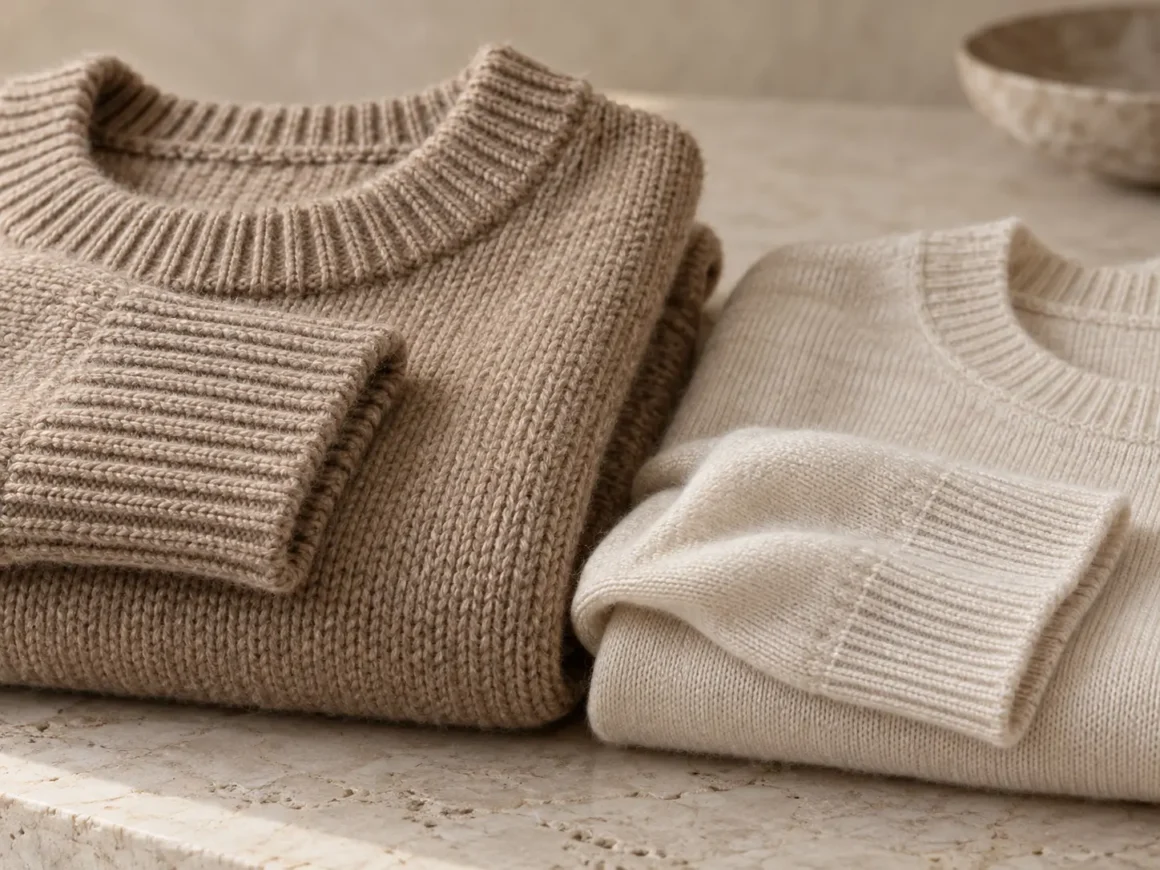
Zoom in on the knit if the site allows it. Look at the neckline, cuffs, seams, and hem. Those details can reveal how carefully the garment is finished and whether the knit appears even.
Pay attention to the silhouette as well. A sweater photographed only in loose, oversized styling can make it harder to judge how much structure the garment actually has.
And finally, read the return policy.
Cashmere is one of those materials that can look convincing online and feel completely different once it is in your hands. A reasonable return window gives you the opportunity to perform the tests that a product page cannot: inspect the surface, feel the density, test recovery, and decide whether the sweater feels substantial enough for its price.
When shopping online, the question becomes less:
Does this sound luxurious?
and more:
Has the brand given me enough evidence to understand what I am actually buying?
Be Careful With Cashmere Marketing Language
Cashmere is surrounded by language that sounds more precise than it often is.
Terms such as Grade A, Mongolian cashmere, two-ply, four-ply, and made in Italy may all tell you something useful. None of them, on its own, tells you whether the finished sweater is good.
Start with Grade A.
You will see it used frequently to suggest especially fine cashmere, but unlike the legal definition of cashmere itself, this kind of grade language is not what the FTC uses to define whether a fiber may be labeled cashmere. The FTC focuses on fiber identity, diameter, fiber content, and country-of-origin labeling—not a consumer-facing A/B/C quality scale.
That does not make every “Grade A” claim meaningless. It simply means you should look for the specifications behind it. If a brand uses the term, does it also tell you anything about fiber fineness, length, yarn construction, or the finished knit?
The same caution applies to origin.
“Mongolian cashmere” identifies where the fiber comes from. “Made in Italy” tells you where the garment was manufactured. Those details may matter to you, and country of origin is information wool products are required to disclose in the United States. But geography alone is not a substitute for judging the fiber and construction.
And as we have already seen, ply describes the way the yarn is constructed—not a luxury ranking.
The useful habit is to translate every impressive-sounding claim into a more practical question:
- Grade A: What does the brand mean by that?
- Mongolian cashmere: What do we know about the actual fiber and yarn?
- Four-ply: Is the additional weight useful for this garment?
- Made in Italy: How well is the sweater actually constructed?
- 100% cashmere: What is the quality of the cashmere itself?
A good product description should make the garment easier to understand, not simply make it sound expensive.
Marketing language can be evidence. It should not be the verdict.
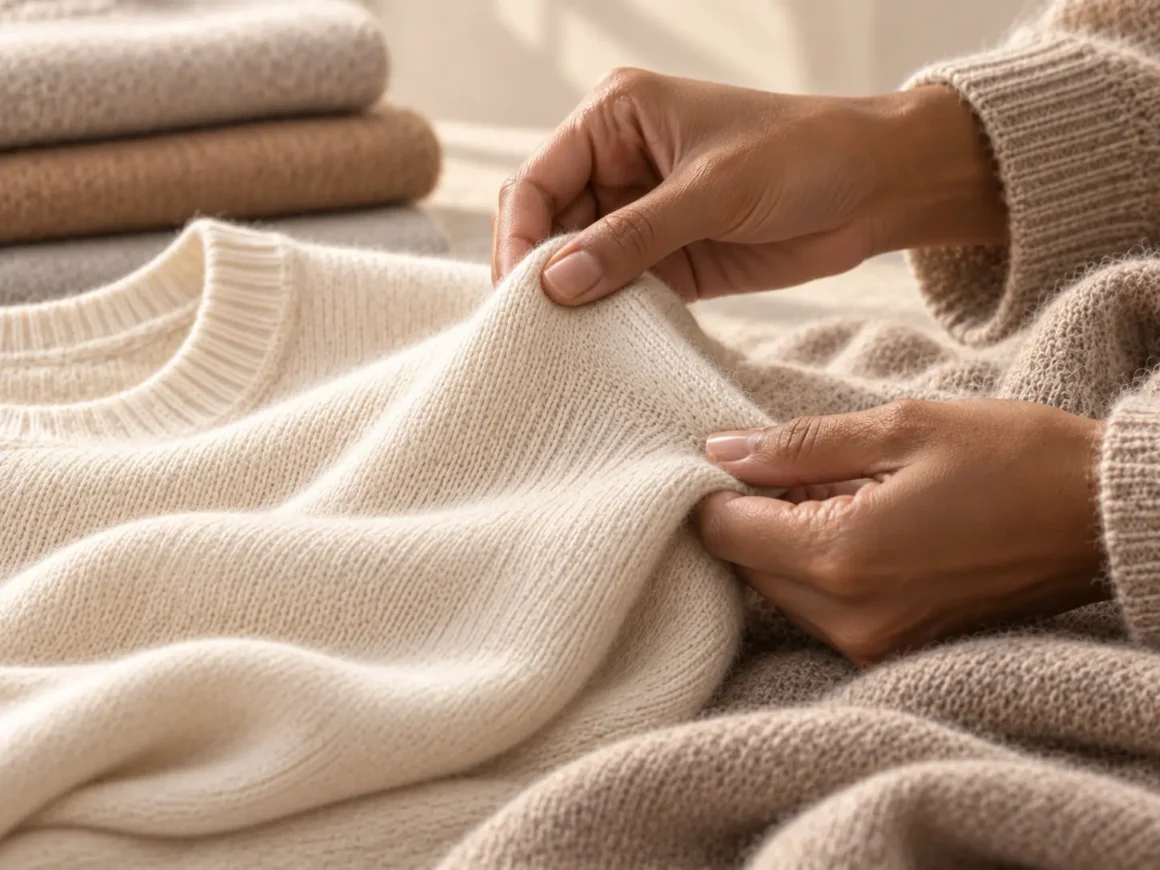
The Five-Minute Cashmere Test
You do not need to know the fiber’s exact micron count to make a better judgment.
If you are standing in a store with a cashmere sweater in your hands, five simple checks can tell you quite a lot.
- Read It
Start with the label.
Confirm the fiber content, then look for any additional information the brand provides about ply, origin, gauge, or construction.
Treat those details as clues rather than guarantees.
- Look at It
Examine the surface before you are distracted by how soft it feels.
A slight halo is normal. What you are looking for is an even knit without excessive fuzz, obvious loose fibers, or areas that already appear thin or unstable.
Check the cuffs, sides, and underarms if the sweater has been handled or worn before.
- Feel It
Good cashmere should feel soft, but softness should come with substance.
Notice whether the sweater feels pleasantly light or simply insubstantial. Run your hand across the surface and pay attention to whether fibers immediately shed onto your fingers or clothing.
The goal is not maximum fluff.
It is softness with enough body to feel like the sweater can survive being worn.
- Stretch It
Gently stretch a small section of the knit and release it.
The fabric should move back toward its original shape rather than remaining distorted or limp.
You are testing resilience, not strength, so this should be a small movement rather than a tug-of-war with the sweater. 😂
- Rub It
Lightly rub a small area of the fabric between your fingers or palms for a few seconds.
A few loose fibers are not necessarily concerning, especially with new cashmere. But if the surface immediately becomes noticeably fuzzier or begins forming small pills, take note.
The point is not to find a sweater that will never pill.
It is to see how readily the surface begins to break down.
Read it. Look at it. Feel it. Stretch it. Rub it.
None of these tests can tell you everything about a sweater in five minutes.
Together, however, they give you a much better picture than the label—or the price tag—can provide on its own.
The Quiet Wardrobe Lens
Buy with a clearer eye.
A good wardrobe is built less by finding more things to want and more by learning what deserves a place in it. The Quiet Wardrobe Lens is a simple framework for looking at quality, usefulness, repetition, and fit before you buy.
Good Enough vs. Excellent Cashmere
Not every cashmere sweater needs to be extraordinary.
Sometimes good enough is genuinely good enough.
A lightweight cashmere sweater you wear under a blazer, a travel layer that gets packed often, or an everyday knit you expect to replace eventually does not need to be made from the longest, finest fibers available to earn its place in your wardrobe.
What matters is whether the quality is appropriate for the price, purpose, and frequency of wear.
A good-enough cashmere sweater should still feel pleasant against the skin, recover reasonably well, and avoid obvious signs of weak construction. It may pill somewhat more quickly. It may feel lighter. It may not hold its surface quite as beautifully over years of wear.
That does not automatically make it a bad purchase.
Excellent cashmere becomes easier to recognize when those qualities improve together.
The fibers tend to feel fine without seeming fragile. The knit has substance without unnecessary bulk. The surface remains relatively controlled. The garment recovers after wear and softens over time without quickly losing its shape.
You may also find that excellent cashmere asks less of you. It does not need to be constantly depilled, reshaped, or handled delicately to continue looking good.
But price alone cannot make that judgment for you.
An expensive sweater can still rely heavily on branding, design, or prestige. A more moderately priced one may be exceptionally well judged for what it is.
The better question is not:
Is this the best cashmere money can buy?
It is:
Is this cashmere good enough for the role I expect it to play—and is the price asking me to believe it is something more?
That distinction leaves room for both discernment and practicality.
The goal is not to buy the finest cashmere that exists. It is to know what you are paying for.
The Small Cashmere Edit
These four sweaters show what cashmere can look like at different price points—from an attainable everyday knit to a true luxury benchmark. The point is not to assume that the most expensive option is automatically the right one, but to compare softness, density, construction, finish, and how each piece earns its place in a wardrobe.

Best value Attainable
Mongolian Cashmere Crewneck
Example: Quince — Mongolian Cashmere Crewneck
A useful entry point for everyday cashmere: simple, wearable, and easy to repeat with trousers, denim, skirts, or beneath a coat.
Shop this sweater
Refined everyday Elevated
Cashmere Crew-Neck Sweater
Example: COS — Cashmere Crew-Neck Sweater
Clean proportions and a restrained silhouette make this the kind of cashmere that can quietly become part of a weekly uniform.
Shop this sweater
Plush + substantial Elevated
Plush Cashmere Crew Neck
Example: Vince — Plush Cashmere Crew Neck
This is where cashmere begins to feel more substantial—the sweater itself carries more of the look rather than simply functioning as a soft basic.
Shop this sweater
Luxury benchmark Investment
Baby Cashmere Crewneck
Example: Loro Piana — Baby Cashmere Crewneck
The luxury end of the comparison: a piece to examine as a benchmark for what exceptional cashmere can feel and look like, rather than as an automatic prescription to spend more.
View this sweaterThis mini edit includes affiliate links. If you choose to purchase through them, The Quiet Luxe Edit may earn a small commission at no additional cost to you.
Before You Buy
Cashmere makes it easy to confuse the reputation of the fiber with the quality of the garment.
Slow the purchase down.
Read the label. Look at the surface. Notice the density and recovery of the knit. Pay attention to what the brand is actually telling you—and what it is leaving to implication.
Then step back from the technical details for a moment.
Ask whether the sweater fills a real role in your wardrobe. Whether you are likely to wear it often enough to justify the price. Whether the color, shape, and weight work with what you already own. And whether you would still want it if the word cashmere were not doing some of the selling for you.
That is where the Purchase Pause becomes useful: not as a reason to avoid buying something beautiful, but as a way to separate genuine value from the momentum of the purchase.
The final question is the same one that applies to almost every material worth buying:
Is this cashmere good at being what it is?
If the answer is yes—and the sweater makes sense for your life—that is usually enough.
Where This Leads
Keep learning what deserves a place in your wardrobe.
Cashmere is one example of a larger skill: learning to look past the label and judge a garment by how its material, construction, and purpose work together.
