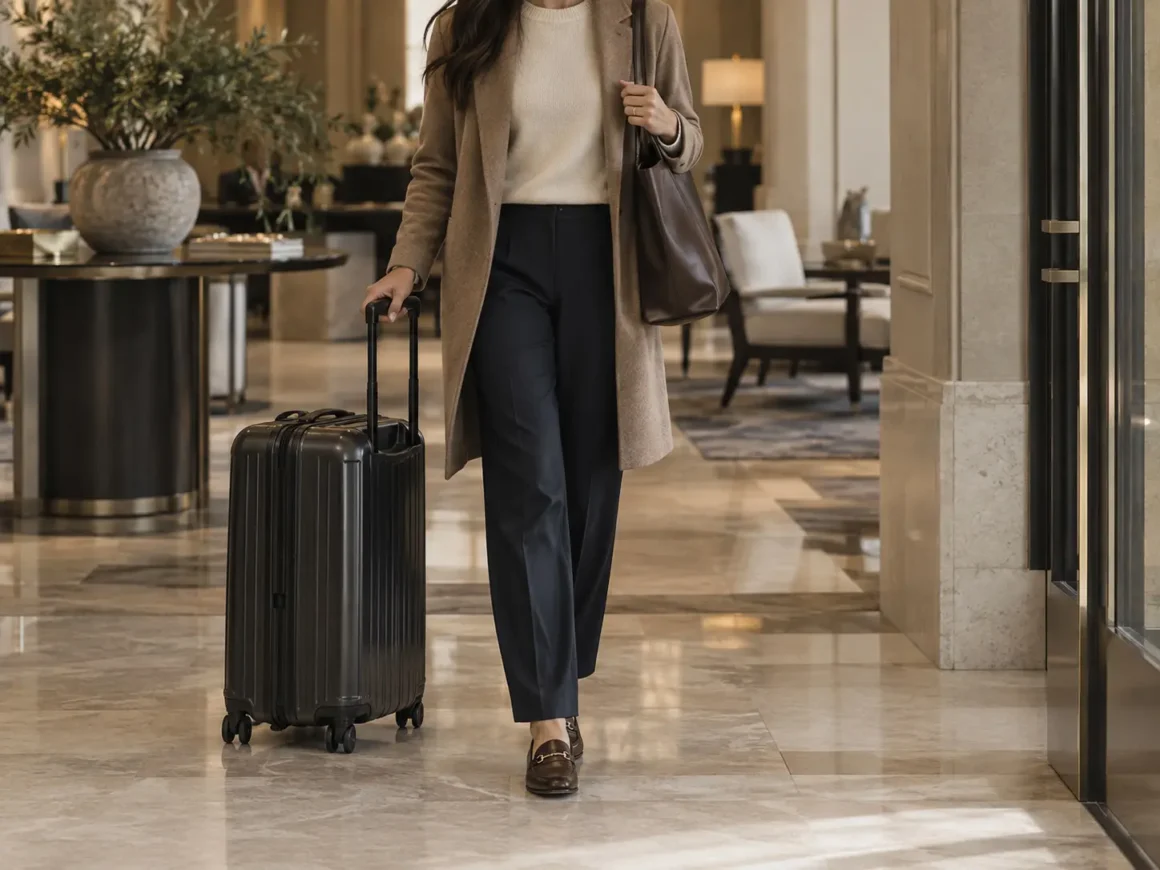
Travel asks more of clothing than an ordinary day does. A single outfit may need to carry you through an early departure, hours of sitting, shifting temperatures, a long walk through an unfamiliar airport, and whatever waits on the other side.
The answer is not necessarily softer clothes, more layers, or a suitcase full of contingencies. It is a small wardrobe chosen with a clearer standard: Can I move through the journey comfortably without feeling as though I have stopped dressing like myself?
A useful travel capsule wardrobe is not built around packing as little as possible. It is built around reducing what your clothing asks of you once the trip begins.
The best pieces repeat easily, recover well, tolerate real movement, and still feel appropriate when transit ends and the actual reason for the trip begins.
The goal is not simply to dress for the journey. It is to dress for arrival.
What a Travel Capsule Actually Needs to Do
A travel capsule has a harder job than an ordinary wardrobe.
At home, clothing can be chosen for one setting at a time. Travel asks the same few pieces to work through long stretches of sitting, changing temperatures, unfamiliar routines, repeated wear, imperfect storage, and whatever the day turns into once you arrive.
That changes the standard.
A useful travel capsule should not simply be small. It should reduce the number of decisions your clothing creates while you are away. Pieces need to work together easily, tolerate repetition, and remain comfortable after hours of movement—or very little movement at all.
They also need to recover well.
A garment that looks polished for twenty minutes but collapses after a flight, wrinkles at the slightest pressure, or requires constant adjusting is not particularly useful in transit. Neither is something so precious that you spend the trip worrying about spills, weather, or whether it can survive being folded.
The best travel pieces tend to do several things quietly:
- feel comfortable enough for long stretches of wear;
- layer without becoming bulky;
- move easily between casual and more polished settings;
- coordinate with most of the other pieces you packed;
- tolerate repetition without feeling noticeably repetitive;
- and still feel like something you would willingly wear at home.
That last point matters.
Travel wardrobes are often treated as a separate species of clothing: softer, stretchier, more technical, and sometimes strangely disconnected from the person wearing them. But comfort does not require abandoning personal style. A travel capsule works best when it feels like a concentrated version of your ordinary wardrobe rather than a temporary costume built for airports. If you’re still defining that foundation, How to Build a Quiet Luxury Wardrobe explores the larger system behind it.
The goal is not to pack the fewest possible pieces.
It is to bring enough of the right ones that clothing becomes one less thing to manage.
Dress for the Arrival, Not Just the Journey
Most travel advice begins with the hours spent getting there.
Wear something soft. Add layers. Choose comfortable shoes. Prepare for a cold plane, a warm terminal, or several hours in a car.
All of that is sensible. But transit is only part of the day.
Eventually, you arrive.
You stand up after hours of sitting. You collect your bag. You walk through a hotel lobby, meet someone at the other end, stop for lunch, pick up a rental car, or go directly to whatever brought you there in the first place.
A good transit outfit should survive that transition without requiring an immediate change of clothes.
This does not mean dressing formally for a flight or sacrificing comfort in the name of appearances. It means choosing comfort that still has enough shape, proportion, and intention to hold together once the journey ends.
A soft trouser with good drape can be as comfortable as something designed purely for lounging. A fine knit can feel easy without looking temporary. A cardigan, jacket, or other structured layer can give an otherwise relaxed outfit definition without making it rigid.
The question becomes less:
What will feel tolerable for six hours?
and more:
What will still feel like me six hours from now?
That small shift changes the entire travel wardrobe.
When you dress only for transit, you often end up packing a second wardrobe for everything that happens afterward. When you dress for arrival as well, the pieces you wear while traveling begin to earn their place in the rest of the capsule.
The trouser worn on the plane becomes part of tomorrow’s outfit. The knit layers under a jacket for dinner. The shoes that carried you through the terminal still make sense when you walk out into the city.
That is where a travel capsule starts to become useful rather than merely efficient.
You are not dressing for the airport.
You are dressing for the trip.
Start with the Transit Outfit
The transit outfit should not be the thing you tolerate until you can change.
It should be the anchor of the capsule.
That means the pieces you wear while traveling should also belong to the rest of the trip. A trouser should work again with a different knit or shirt. A cardigan or jacket should layer over more than one outfit. The shoes should make sense beyond the terminal.
This is where many travel wardrobes become inefficient. The “travel outfit” is treated as a special category—stretchy, oversized, highly casual—while the rest of the suitcase is packed for the actual destination. The result is often one outfit that takes up space but contributes very little once you arrive.
A better approach is to start with the pieces you already know you can wear for hours without thinking about them.
The ideal transit outfit usually has a few things in common:
- nothing pinches, pulls, or needs constant adjustment;
- the fabric has enough structure or drape to recover after sitting;
- layers can be added or removed without making the outfit feel bulky;
- the shoes are comfortable enough for real walking;
- and every major piece can be worn again somewhere else in the trip.
The last point matters most.
If the trouser only works on the plane, it is probably not earning its place. If the cardigan only exists because airports are cold, it may be doing less work than another layer already in the capsule.
Instead, think of the transit outfit as look one of the trip, not a prelude to it.
For a polished travel capsule, that might mean a soft trouser with good drape, a fine-gauge knit or relaxed shirt, a cardigan or lightly structured jacket, and a shoe you can walk in without looking as though you dressed specifically for security lines.
The exact pieces will depend on the trip, but the principle is the same:
Begin with the outfit that has to work the hardest, then build outward from there.
Once the transit outfit is right, the rest of the capsule becomes easier to see. You already have your first trouser, first top, first layer, and one pair of shoes. The question becomes not What else should I pack? but What few pieces will make these work in more ways?
That is a much better place to begin.
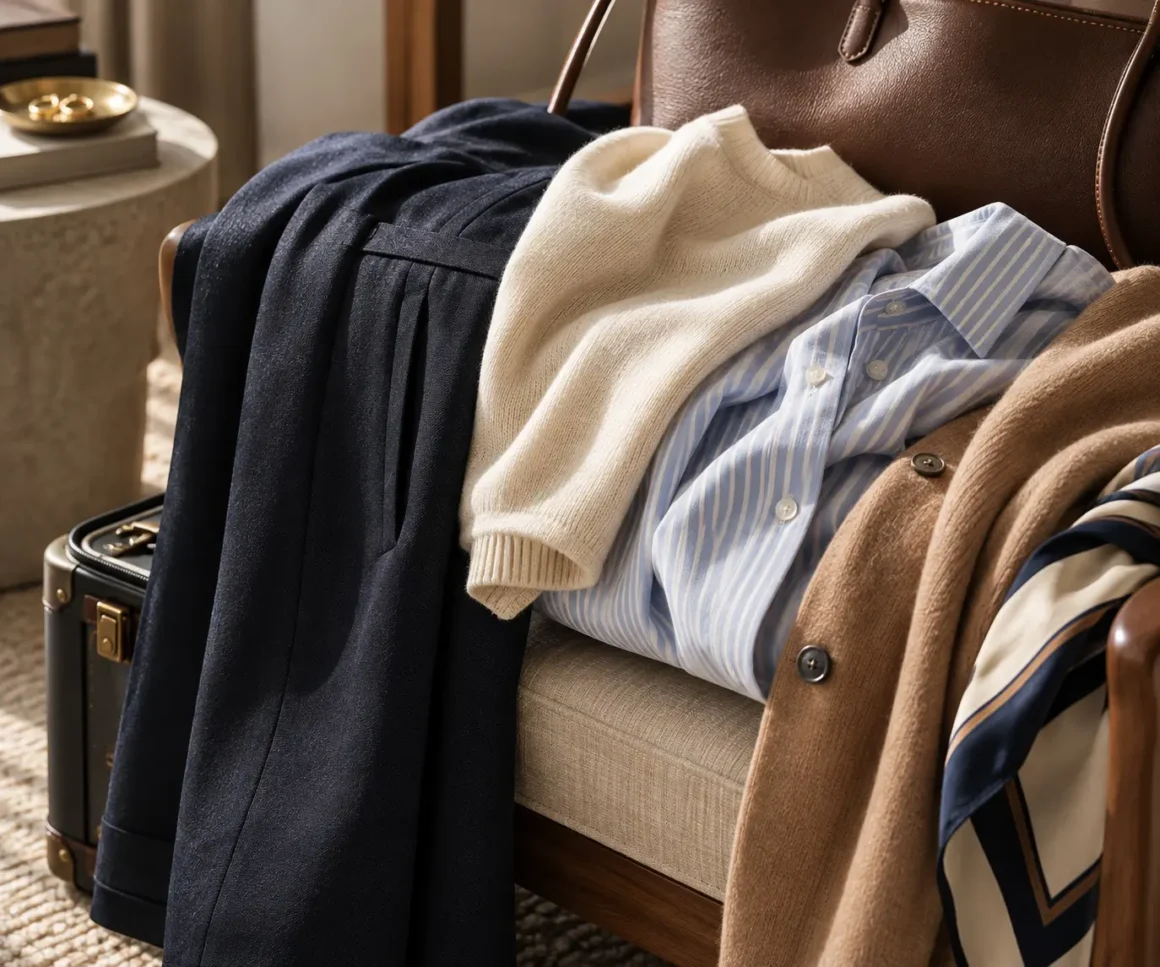
Choose Fabrics That Travel Well
Travel exposes fabric quickly.
A material that feels perfectly acceptable for a short dinner or an ordinary workday may become irritating after several hours of sitting, temperature changes, carrying bags, or moving through crowded terminals. Wrinkles become more obvious. Poor recovery shows up faster. A fabric that traps heat or clings when you move can turn a polished outfit into something you want to escape from before you arrive.
That is why travel-friendly fabric is about more than wrinkle resistance.
The best choices tend to have a few qualities in common: they drape well, recover after being compressed, breathe reasonably well, and feel comfortable against the skin for long periods of time. They should also tolerate repetition without looking tired after one wear.
Wool is particularly useful here. A fine merino knit can regulate temperature, resist odor better than many synthetics, and recover well between wears. Lightweight wool trousers can hold their line without feeling rigid, especially when the fabric has enough softness and movement.
Cashmere can work beautifully for travel too, particularly as a layer, but it does require a little more care. I like it best when the piece can be worn more than one way—a cardigan that works in transit, at dinner, and again the next morning earns its place much more easily than a delicate sweater packed for a single outfit.
Silk can be excellent when the weave and cut are practical, but not every silk travels equally well. A fluid blouse that layers cleanly and tolerates a little creasing may be useful; something that shows every wrinkle or water mark probably creates more anxiety than ease.
Cotton is comfortable, but some versions crease aggressively. Linen wrinkles too, of course, but that does not automatically make it a poor travel fabric. The question is whether the wrinkling looks natural and relaxed or simply rumpled. A linen blend with some structure or weight often travels more gracefully than a very crisp, lightweight linen.
Synthetics can be useful when chosen carefully. A technical fabric with good breathability, stretch, and recovery can make sense for certain trips. But a fabric that feels plasticky, traps heat, or develops static after a few hours is not earning points simply because it came out of the suitcase wrinkle-free.
The useful test is not:
Will this wrinkle?
Almost everything will, eventually.
A better question is:
What does this fabric look and feel like after it has been worn for six hours?
That is the version of the garment you are actually traveling in.
The same qualities that make clothing look composed at home—drape, finish, construction, and the way a fabric moves—matter even more after hours in transit. What Makes Clothes Look Expensive? Fabric, Drape, and Finish looks more closely at how to recognize them.
Before packing something, it can help to wear it for a full ordinary day at home. Sit in it. Walk in it. Layer over it. Notice whether it stretches out at the knees, pills where a bag rubs, holds onto odor, or makes you unusually aware of your body.
Travel is rarely the ideal time to discover that a fabric only behaves well when you stand still.
The best travel materials are not necessarily the most technical or the most expensive. They are the ones that continue to feel composed after real use—and ask very little of you in return.
Build Around a Tight Color Palette
A tight color palette is one of the easiest ways to make a small travel wardrobe feel larger than it is.
The goal is not to reduce everything to black, beige, and navy. It is simply to make sure the pieces you bring speak the same visual language.
When colors coordinate easily, repetition becomes less obvious. The same trouser can work with several tops. A cardigan can layer over a dress one day and a shirt the next. Shoes stop dictating entire outfits. Suddenly, eight or ten pieces behave more like fifteen.
That matters when you are traveling because every piece is competing for limited space.
A useful palette usually begins with one or two base colors—the shades that show up in the pieces doing the most work. That might be navy and cream, chocolate and ivory, charcoal and camel, black and soft gray, or something more personal entirely.
Then add one or two supporting colors that already sit comfortably beside them.
The important word is already.
Travel is not the moment to build a new color story from scratch. If burgundy, olive, pale blue, or soft pink already works naturally with the clothes you wear most, it can absolutely belong in the capsule. But adding a color simply because it looks appealing on a packing list often creates an orphan piece that only works one way.
A quick test helps:
Can this piece be worn with at least two other things I am already packing?
If the answer is no, it may still deserve a place—but it should have a good reason.
The same principle applies to prints. A print is not automatically impractical for travel. In fact, a subtle stripe, small pattern, or familiar motif can keep a capsule from feeling too uniform. The question is whether it integrates with the rest of the wardrobe or demands its own supporting cast.
This is also where accessories can do more than clothes.
A scarf, belt, bag, or pair of earrings can shift the mood of repeated outfits without requiring another sweater, another jacket, or another pair of trousers. When the clothing palette is cohesive, small details become more visible.
There is another advantage to keeping the palette tight: packing mistakes become less expensive.
If weather changes or plans shift, you have more ways to recombine what you brought. A top intended for dinner can move into daytime. A trouser packed for meetings can work with a knit for a casual afternoon. An outer layer does not have to match only one outfit.
That flexibility is more useful than packing a separate look for every possible occasion.
A travel capsule should not feel as though each outfit was sealed into its own little bag.
It should feel interchangeable.
The easiest way to know whether the palette is working is to lay everything out before you pack. Not by outfit—by category.
Put all the tops together. All the bottoms. The layers. The shoes.
If most pieces can move easily across the group, the capsule has structure. If several items immediately announce, I only work with that one thing over there, you may be packing individual outfits rather than a wardrobe.
There is nothing wrong with bringing one special piece for a specific evening or event. Travel does not require ruthless practicality.
But the foundation should be quieter than that.
A tight palette gives you room for one or two exceptions precisely because everything else is doing so much work.
The aim is not fewer colors for the sake of restraint.
It is more combinations with less negotiation.
And when you are already navigating schedules, luggage, unfamiliar places, and the small unpredictabilities of travel, that is exactly what a good capsule should give you.
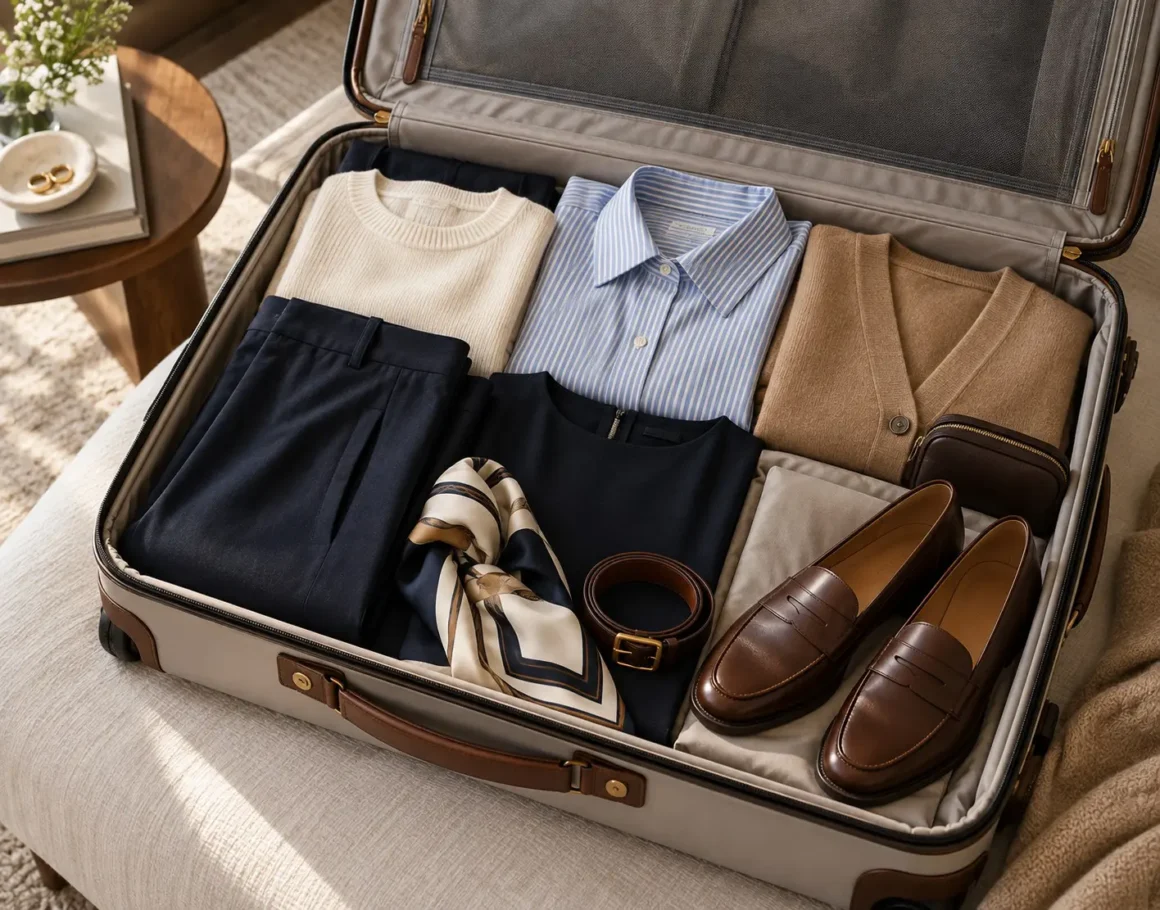
Choose Pieces That Earn Their Place
A travel capsule does not need every piece to be endlessly versatile.
It does need every piece to have a reason for being there.
That distinction matters, because “versatile” can become its own kind of packing anxiety. Suddenly every sweater is expected to work with every trouser, every shoe has to go from sightseeing to dinner, and every dress is supposed to be appropriate for three completely different occasions.
Real trips are not that tidy.
Some pieces are useful because they work in several settings. Others earn their place because they solve one specific problem exceptionally well. The point is not to make every garment perform like a Swiss Army knife. It is to avoid bringing pieces that contribute very little once the suitcase is closed.
A useful question is:
What job is this piece doing on the trip?
A cardigan may earn its place because it layers over almost everything and handles temperature changes. A dress may be worth packing even if it only works for one dinner because that dinner matters. A second pair of shoes may make sense because the trip involves a great deal of walking and your feet need the break.
What matters is that the answer is clear.
The pieces that tend to earn their place most easily are the ones that solve more than one need without feeling compromised. A trouser that works in transit and again for dinner. A knit that layers under a jacket but is polished enough to wear alone. A shirt that can be tucked, worn open over a tank, or paired with a skirt later in the trip.
That kind of usefulness is quieter than “maximum versatility.” It is simply a garment doing enough work to justify the space it takes up.
The opposite is the piece packed for an imaginary version of the trip.
The extra blouse for the dinner that may or may not happen. The second jacket because the first one suddenly feels too casual in your imagination. The shoes that only make sense with one outfit. The dress you have not worn in months but somehow believe travel will transform into exactly the right choice.
Those pieces usually reveal themselves before you leave.
If you find yourself inventing scenarios to justify packing something, pay attention.
A good travel capsule is built around the trip you are actually taking, not every version of the trip that could theoretically unfold.
It can help to divide potential pieces into three quiet categories:
- anchors — the pieces doing the most repeated work;
- supporting pieces — the tops, layers, and accessories that create variation;
- specific-purpose pieces — items packed for a known event, climate, or activity.
Most of the capsule should come from the first two categories. The third should be small and deliberate.
And there is another test worth using:
Would I be disappointed if I had to wear this twice?
If the answer is yes, the piece may not belong in a small travel wardrobe.
Repeating clothes is not a packing failure. It is the entire premise of a capsule.
The pieces that earn their place are the ones you are happy to reach for again—because they still feel good, still look right, and do not make you wish you had packed something else.
That is a much more useful standard than novelty.
A suitcase has limited room. Your attention does too.
The best pieces respect both.
Shoes Have to Survive the Actual Trip
Shoes are where travel capsules tend to become unrealistic.
They are often chosen for the outfit they complete rather than the trip they have to survive.
A shoe can look perfect standing in front of a mirror and become completely wrong after twenty minutes of walking through an airport, across uneven pavement, up hotel stairs, or around a city you underestimated on the map.
That does not mean travel requires giving up polish.
It means the standard has to be higher.
A useful travel shoe needs to work with the wardrobe, but it also needs to work with your feet.
That sounds obvious until you look at how often shoes are packed because they are technically wearable rather than genuinely comfortable. A pair that is fine for dinner at home may not be fine after a full day of walking. A shoe that feels stable on smooth floors may behave very differently on cobblestones, hills, rain, or long stretches of concrete.
The best travel shoes usually have one thing in common:
You already trust them.
Travel is not the ideal moment to break in a new pair, test an unfamiliar heel height, or discover that a shoe rubs after the third mile.
If you have to convince yourself that a shoe will probably be comfortable enough, it may not belong in the suitcase.
For most trips, two pairs are often more useful than three mediocre ones: one pair capable of handling real walking, and one that shifts the wardrobe slightly more polished when needed.
That does not have to mean sneaker plus dress shoe.
Depending on your style and destination, it might be a supportive loafer and a low heel, a polished walking shoe and a refined sandal, or two comfortable options with different levels of structure.
The point is not the category.
It is that each pair solves a different problem.
This is also where color matters more than people expect. A shoe that only works with one trouser or one dress creates unnecessary packing friction. The more easily both pairs move through the capsule, the less likely you are to pack a third simply to rescue one outfit.
And shoes deserve a stricter version of the “earn their place” test because they take up so much physical room.
Ask:
Can I comfortably wear these for the amount of walking this trip actually requires?
Do they work with more than one outfit?
Would I still choose them if I had to wear them two days in a row?
If the answer is no, the shoe may be decorative luggage.
There are exceptions, of course. A wedding, formal dinner, or specific event may justify a pair that does one job and nothing else. But that should be a conscious exception, not the foundation of the capsule.
The easiest way to travel with fewer shoes is not to become less particular about them.
It is to become more particular before they go into the bag.
A good travel shoe should let you walk farther than expected, stand longer than planned, and arrive without thinking about your feet every few minutes.
Because once shoes start demanding attention, the rest of the outfit hardly matters.
And that is the same standard running through the entire capsule:
The best pieces are the ones that let you stay focused on the trip instead of managing what you are wearing.
A Few Outfit Formulas Are Better Than Endless Options
A travel capsule becomes much easier to use when you stop asking yourself to create a new outfit every day.
A few reliable formulas are usually more useful than a suitcase full of possibilities.
The point is not to make travel dressing repetitive in a dull way. It is to reduce the amount of reinvention required each morning.
When the same basic structure can be repeated with different pieces, getting dressed becomes faster and the wardrobe begins to feel more cohesive. You are changing the components, not rebuilding the entire idea from scratch.
For example:
Trouser + knit + structured layer
This works especially well for transit days, casual meetings, lunches, or evenings when you want to feel pulled together without becoming formal.
Trouser + relaxed shirt + polished shoe
A simple formula that can shift easily depending on the fabric, accessories, and how the shirt is worn.
Skirt + fine knit + comfortable shoe
Useful when you want something softer than tailoring but still refined enough to move through different parts of the day.
Dress + cardigan or jacket + walking-friendly shoe
One piece does most of the work, while the layer and shoe determine whether the outfit reads more relaxed or more polished.
Base layer + trouser or skirt + outer layer
A particularly useful formula when temperatures are unpredictable and you need to adjust throughout the day without changing the entire outfit.
These do not need to become rules.
They are simply structures you already know how to wear.
That familiarity matters in travel because an outfit formula removes one more variable. You know the proportions work. You know which layers sit comfortably together. You know whether the shoes make sense with the hemline.
And because the color palette is already tight, repeating a formula does not necessarily mean repeating the same look.
The navy trouser worn with an ivory knit and cardigan one day can return with a pale blue shirt and loafers two days later. The structure is familiar; the expression changes.
This is also where accessories become useful.
A scarf, belt, jewelry, or different shoe can shift the mood of a familiar combination without requiring another full outfit. Small changes register more clearly when the wardrobe itself is restrained.
There is no prize for wearing something completely different every day of a trip.
In fact, trying to avoid repetition often creates exactly the kind of suitcase a capsule is supposed to prevent: too many pieces, too many one-off combinations, and too much time spent deciding what goes with what. Repetition is part of what makes a small wardrobe useful. Why Repeating Outfits Is the Point explores why familiarity often creates more confidence, not less.
A few good formulas give the wardrobe rhythm.
You begin to know instinctively what works, which pieces can trade places, and what to reach for when plans change.
That is the kind of repetition worth building into a travel capsule.
Not because you have run out of options.
Because you already know which ones work.
What You Probably Don’t Need to Pack
Overpacking rarely begins with things you know you need.
It usually begins with contingencies.
The extra dress in case dinner is nicer than expected. The second jacket in case the first suddenly feels wrong. The shoes that only work with one outfit. The top you have not worn in months but somehow imagine becoming indispensable in another city.
Travel has a way of making hypothetical versions of ourselves feel very persuasive.
A useful capsule asks you to pack for the trip that is actually happening, not every possible version of it.
You probably do not need:
- several “just in case” outfits for plans that are not on the itinerary;
- duplicate pieces that solve the same problem;
- shoes with only one narrow purpose;
- clothing that requires special undergarments you do not usually enjoy wearing;
- pieces that wrinkle badly, itch, pinch, or need constant adjustment;
- anything you already avoid at home because it never quite feels right;
- or an entirely separate wardrobe for transit.
None of these are forbidden, of course. The point is simply to notice when a piece is being packed because it is useful and when it is being packed because uncertainty is uncomfortable.
That distinction can save a surprising amount of space.
The hardest pieces to leave behind are often the ones that seem theoretically perfect.
A dramatic dress. A beautiful heel. A second coat. A blouse that works beautifully with exactly one pair of trousers.
If the trip genuinely calls for them, bring them.
But a useful question is:
What happens if I leave this behind?
If the answer is, I would wear one of the other outfits I already packed, that is usually good information.
The same is true of backups.
One extra top may be practical. Three extra tops because you are imagining spills, weather changes, mood changes, and mysterious wardrobe emergencies usually means the capsule has started turning back into a closet.
Packing lightly does not require optimism about everything going perfectly.
It requires confidence that the pieces you brought can absorb a little imperfection.
A cardigan can handle a colder evening. A repeated trouser can survive a changed plan. A dress can be worn twice. A shoe can work for both dinner and the next afternoon.
And if something truly unexpected happens, most destinations contain stores. 😂
You do not need to carry every possible solution with you from home.
There is also something worth noticing about the clothes you repeatedly decide not to wear before you leave.
If you put something into the suitcase, take it out, reconsider it, and put it back several times, the hesitation itself may be the answer.
A travel capsule should feel relatively obvious by the time you close the bag.
Not perfect.
Not optimized down to the ounce.
Just clear enough that you trust what is inside.
The goal is not to prove how little you can travel with.
It is to stop packing against every imagined inconvenience.
A smaller suitcase feels better when what you leave out was never going to help much anyway.
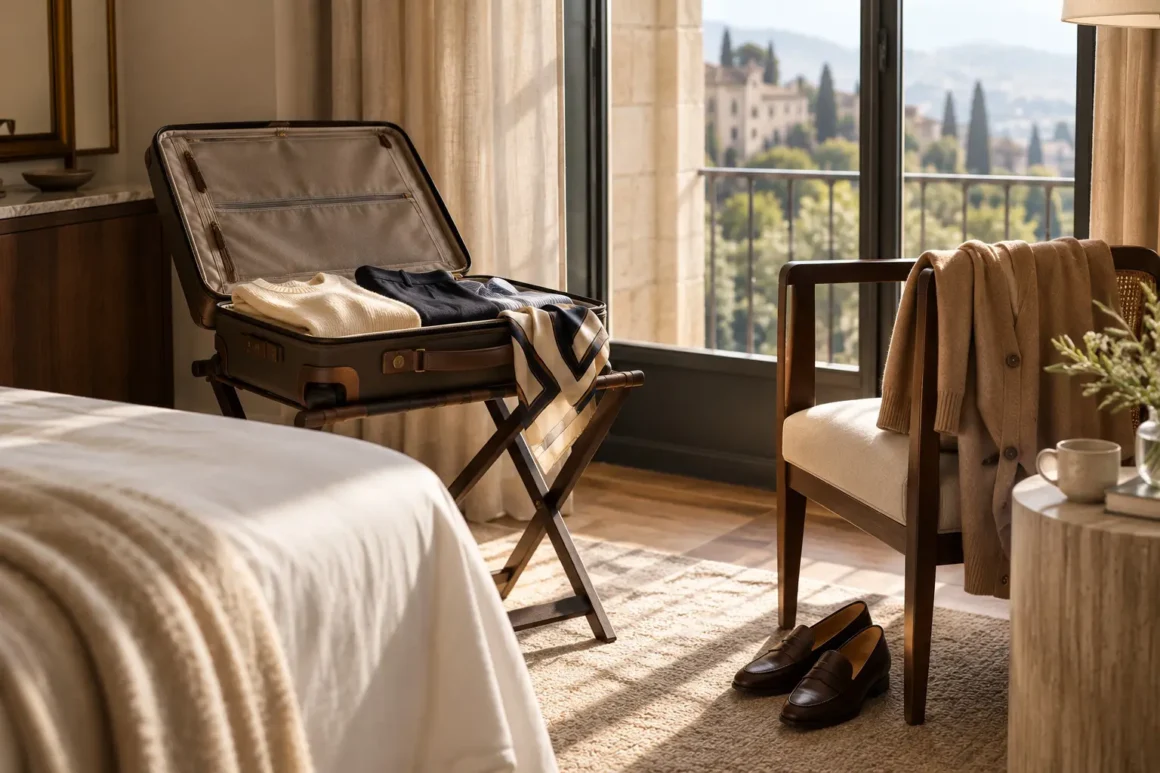
The Pleasure of Traveling With Less
There is a point in a good trip when you stop thinking about what you packed.
That is the pleasure of traveling with less.
Not because the suitcase is impressively small or because you managed to optimize every outfit down to the last accessory, but because the clothing has stopped asking for attention.
You know what works.
You know which trouser goes with which knit. You know which shoes can handle the day. You know what to reach for when the temperature drops or dinner becomes slightly nicer than expected.
The wardrobe becomes familiar very quickly.
And familiarity is useful when everything else around you is changing.
A smaller travel capsule reduces the number of decisions you have to make in an unfamiliar environment. You spend less time standing in front of an open suitcase, less time wondering whether something coordinates, less time reorganizing clothes you packed but never seem to want to wear.
There is also less physical management.
Fewer pieces to fold, hang, steam, repack, keep track of, or carry through the next leg of the trip.
That matters more than it sounds.
Luggage has a way of becoming its own responsibility. The more you bring, the more you have to manage—not only while packing, but every time you move from one place to another.
Traveling with less makes room for the trip itself.
For noticing where you are.
For staying out longer because you are comfortable.
For changing plans without wondering whether you packed the right outfit for them.
For wearing the same cardigan again because it worked beautifully yesterday and there is no reason it should not work beautifully today. That familiarity is part of the pleasure. The Pleasure of Wearing the Same Things Again explores what happens when repetition stops feeling like compromise and starts becoming part of personal style.
Repetition begins to feel less like compromise and more like ease.
There is a quiet confidence in opening a suitcase and seeing only things you genuinely want to wear.
No aspirational pieces.
No backup wardrobe.
No collection of contingencies waiting to become decisions.
Just a small group of clothes you already trust.
That may be the real luxury of a travel capsule.
Not novelty.
Not abundance.
Not proving how efficiently you packed.
Simply having less between you and the experience you came for.
The best travel wardrobe does not make the trip more interesting.
It makes itself less interesting.
And once that happens, your attention is free to go somewhere better.
Travel lightly. Dress like yourself.
A useful travel capsule begins with the same principles as a useful wardrobe at home: pieces that work together, materials that hold up, and enough familiarity to make repetition feel easy.
