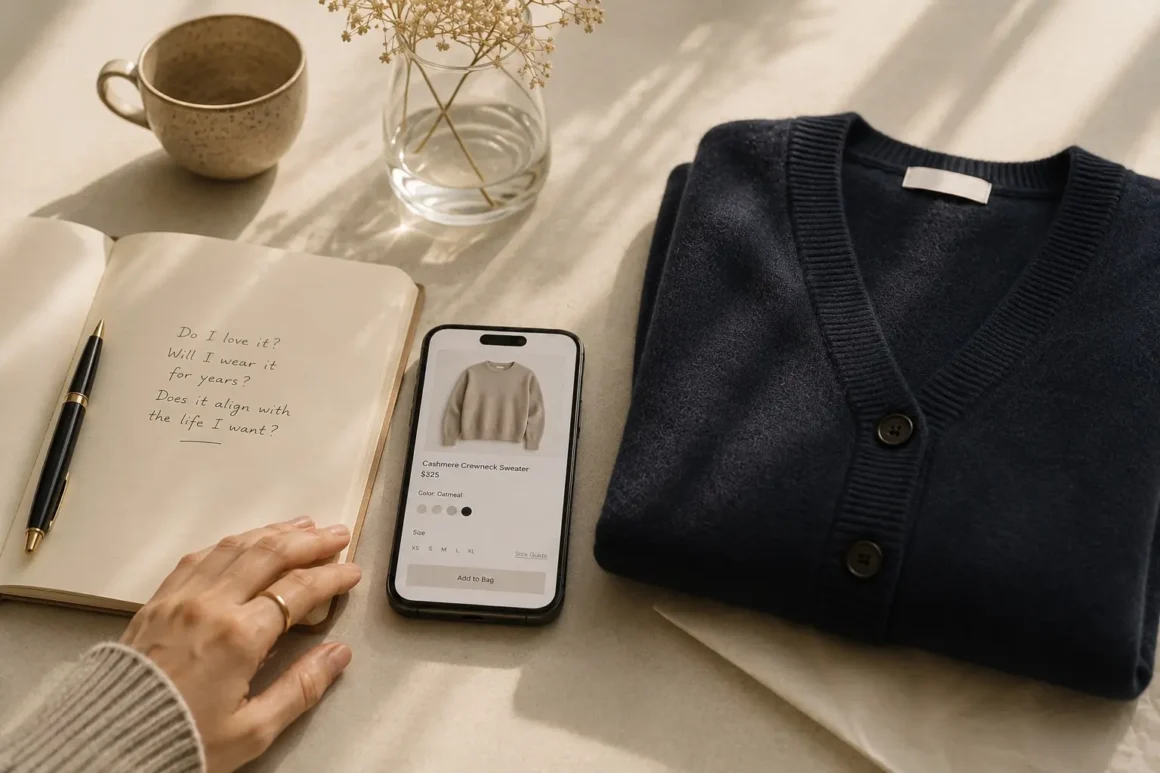
Most purchases do not begin with a clear yes. They begin with momentum. A beautiful coat catches your eye. Your size is still available. The sale ends tonight. Suddenly, the question is no longer whether the piece belongs in your wardrobe, but whether you can decide before the opportunity disappears.
A purchase pause interrupts that momentum. It does not ask you to stop wanting beautiful things or prove that you can walk away. It simply creates enough distance for the decision to become yours again.
In that pause, the item has to stand on more than urgency. You can consider how it fits, what it works with, whether it solves a genuine need, and whether you still want it once the pressure quiets. The answer may still be yes. The difference is that it is a yes shaped by clarity rather than persuasion.
That is the purpose of the Purchase Pause: not to buy less at any cost, but to choose with greater confidence.
The Short Answer
What Is a Purchase Pause?
A purchase pause is an intentional space between wanting something and deciding whether to buy it. It gives you time to evaluate the item based on fit, usefulness, cost, and how it works with the wardrobe you already own—rather than urgency, scarcity, or the excitement of something new.
The goal is not to prevent the purchase. It is to return the power of choice to you. The answer may still be yes, but it becomes a decision shaped by clarity rather than pressure.
The Moment Before the Purchase Matters
A disappointing purchase is not always a bad item. Sometimes it is simply a decision made too quickly—or under conditions that made clear thinking more difficult.
The moment before checkout is crowded with influence. A low-stock warning appears. The sale ends at midnight. Free shipping is only a few dollars away. The item has been styled so beautifully that you begin imagining not only the piece, but the life that seems to come with it.
None of this means the desire is false. You may genuinely like the item. It may even be well made, flattering, and reasonably priced. But liking something is not the same as knowing that it belongs in your wardrobe.
That distinction is easiest to lose when momentum takes over.

Once a piece is in the cart, the decision can begin to feel partially made. You have chosen the color, selected the size, calculated the discount, and pictured yourself wearing it. Checking out starts to feel like the natural conclusion rather than one possible outcome.
One useful approach is to move uncertain items out of the cart and onto a wishlist. In Why Wishlists Beat Shopping Carts, I explore how that small shift creates enough distance for interest to become a genuine decision rather than borrowed momentum.
Your own circumstances matter, too. Fatigue, boredom, disappointment, celebration, and the desire for a fresh start can all make a purchase feel more meaningful in the moment. Sometimes we are drawn not only to the object, but to what we hope it will change: our wardrobe, our confidence, our routine, or even the way we feel that day.
A purchase pause creates a small break in that momentum.
It gives you the opportunity to separate the item from the conditions surrounding it. Is the piece still compelling without the countdown? Does it work with the life and wardrobe you have now? Would you choose it at this price if no one were telling you that time was running out?
The moment before a purchase matters because it is often the last point at which urgency, persuasion, and genuine preference can still be separated.
The goal is not to distrust every desire. It is to make sure the final decision reflects your judgment—not simply the pressure surrounding it.
A Purchase Pause Is Not a Shopping Ban
A purchase pause is not a test of restraint, and it is not a rule that every desire should end in no.
The purpose is not to prove that you can walk away from something beautiful. It is to create enough space to decide whether the item deserves a place in your life—and to make that decision without pressure doing the thinking for you.
Sometimes the pause leads to a clear no. The excitement fades, the wardrobe gap turns out not to be real, or the piece begins to feel less compelling once the sale message disappears.
Sometimes it leads to a better alternative. You may realize that a different color, fabric, shape, or price point would serve you more effectively. You may discover that something already in your wardrobe solves the problem just as well.
And sometimes the answer remains yes.
That yes matters.
A thoughtful purchase can still be pleasurable, indulgent, and entirely unnecessary in the strictest sense. Not every beautiful object has to solve a practical problem before it is allowed into your life. The pause simply asks whether you are choosing it deliberately—and whether you understand what you are choosing.
That distinction keeps the practice from becoming punitive. You are not withholding something from yourself. You are giving yourself the opportunity to want it clearly.
The purpose of the pause is not to prevent the purchase.
It is to make sure the purchase remains yours.
What Becomes Clear When You Wait
When you stop trying to answer the question immediately, the question itself begins to change.
At first, the decision may feel simple: Do I want this? But desire is only one part of a thoughtful purchase. Given a little time, other considerations begin to surface—how the piece fits into your wardrobe, whether it duplicates something you already own, what it will require from you, and whether you still want it once the excitement has settled.
The purchase pause does not manufacture doubt. It makes room for information that was difficult to hear while the decision felt urgent.
The excitement settles
The first few hours after discovering something can be unusually persuasive. The item is new to you. It has been beautifully styled. You may already be imagining where you will wear it, how it will change an outfit, or how pleased you will feel when it arrives.
Sometimes that excitement remains. Sometimes it does not.
When the initial charge fades, you can see whether the item itself is still compelling—or whether you were responding mainly to the pleasure of discovery. A piece that continues to hold your attention after the novelty has softened deserves a closer look. One that becomes surprisingly easy to forget may already have given you your answer.
The wardrobe becomes visible again
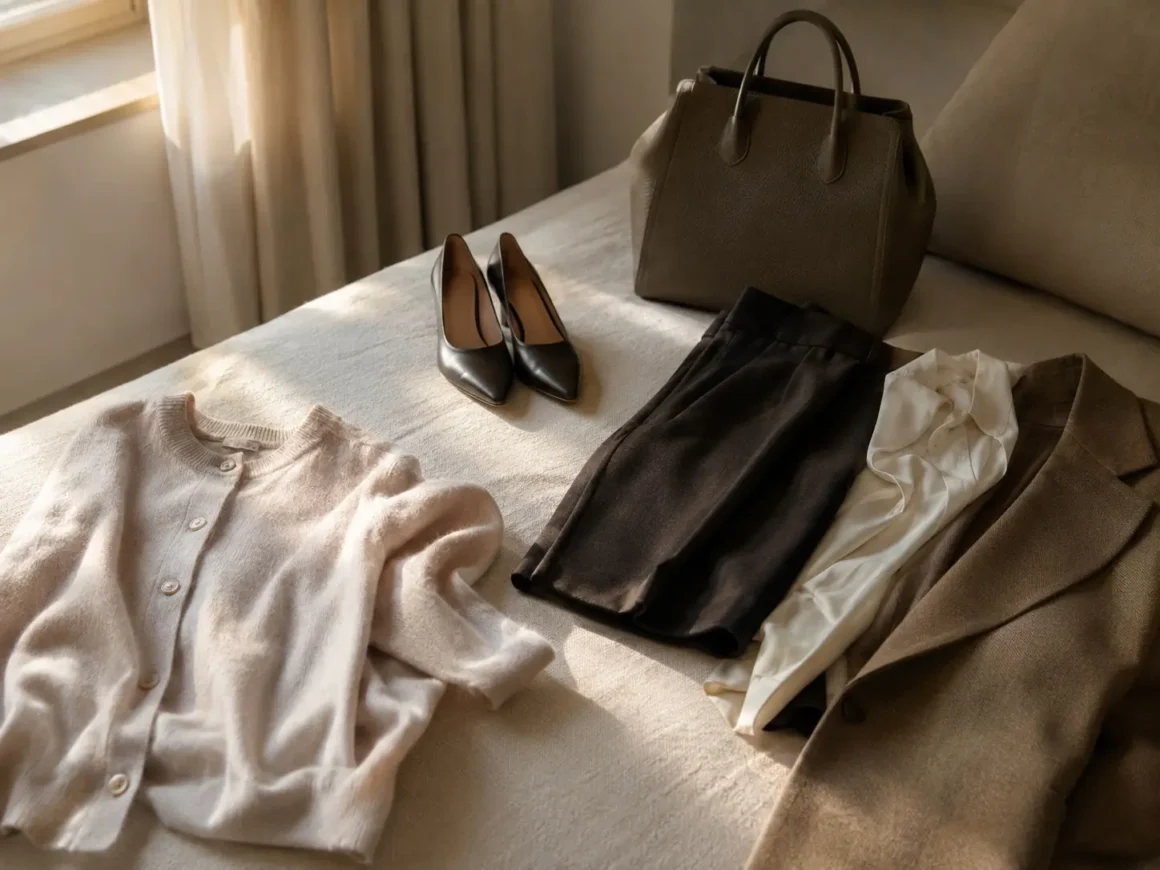
Shopping often places the new item at the center of the decision. Waiting brings the rest of your wardrobe back into view.
You begin to think less about the outfit shown on the product page and more about the clothes you actually own. What would you wear with it? Does it work with your usual shoes, layers, and proportions? Can you picture it in several real situations, or only in one beautifully imagined version of your life?
This does not mean every purchase must perform endless practical labor. A special piece can be worthwhile simply because it gives you pleasure. But even then, it helps to understand whether you are choosing it for the wardrobe you have—or for one you would need to build around it.
A strong wardrobe is rarely built by repeatedly starting over. As I explore in How to Build a Quiet Luxury Wardrobe Without Overbuying or Overthinking, it develops through selective additions that strengthen what is already there.
Duplication becomes harder to ignore
A new item can feel distinct when viewed alone. Once you place it mentally beside the rest of your wardrobe, its role may look more familiar.
Perhaps you already own three versions of the same navy cardigan. Maybe the new trousers are slightly different, but not different enough to create new outfits. Or perhaps the apparent duplication is useful: you repeatedly wear that shape, color, or category, and another version would genuinely support the way you dress.
The pause helps you distinguish between repeating a successful formula and buying the same solution again because it feels safe.
Both may look similar from the outside. Only one meaningfully strengthens the wardrobe.
The true cost comes into focus
Price is rarely the full cost of a purchase.
A garment may need alterations. A delicate fabric may require dry cleaning. A pale shoe may demand more maintenance than you realistically want to give it. A beautiful dress may be reasonably priced but still expensive in relation to how rarely your life provides an occasion to wear it.
Waiting gives you time to consider not only what the item costs to acquire, but what it may cost to own.
That does not make higher-maintenance pieces wrong. It simply allows you to choose them knowingly. There is a difference between caring for something beautiful because you decided it was worthwhile and resenting the upkeep because you never considered it at all.
The longer you wait, the more the purchase begins to exist in reality rather than imagination.
You see the item more clearly, but you also see yourself more clearly: your habits, your wardrobe, your tolerance for maintenance, your actual needs, and the kinds of pieces you return to again and again.
That is what the pause is for.
It does not take the pleasure out of wanting something beautiful. It simply lets reality back into the conversation.
The Pause Should Match the Decision
Not every purchase requires the same amount of reflection.
Replacing a familiar white T-shirt is different from buying a coat that costs more than your monthly grocery budget. A pair of everyday shoes that fills an obvious gap does not carry the same weight as a beautiful handbag you have admired for years. Treating every decision as equally significant can make the purchase pause feel rigid rather than useful.
The pause should be proportionate to the choice.
For a familiar replacement, one night may be enough to confirm what you already know. A discretionary addition may deserve several days—long enough to consider how it fits into the wardrobe and whether the interest remains once the novelty fades. A costly, highly aspirational, or difficult-to-return purchase may need considerably more time.
Price matters, but it is not the only consideration.
A relatively inexpensive item can still deserve a longer pause if you are buying it emotionally, duplicating something you already own, or trying to solve a problem that clothing cannot solve. An expensive purchase may require less uncertainty if you have researched it carefully, saved for it intentionally, and returned to it consistently over time.
The pause is not really measured by the number of days that pass.
It is measured by what becomes clear during that time.
Can you explain the role the item will play? Do you understand its full cost, including care and alterations? Does it suit your actual life? Are you still drawn to the piece itself, or mainly to the feeling of getting something new?
Once those questions have honest answers, the decision often becomes much quieter.
That is the point. The purchase pause should not create unnecessary hesitation. It should create enough space for the scale of the decision to come into focus—then allow you to move forward with confidence.
A Thoughtful Yes Still Matters
A purchase pause is not designed to talk you out of buying something.
Sometimes the excitement settles, the practical questions are answered, and the item still feels right. It works with what you own. It suits your actual life. The cost feels reasonable within your priorities. You have considered the alternatives, and you continue to return to this particular piece.
That is valuable information.
A thoughtful yes may feel quieter than an impulse purchase. There is less adrenaline, less urgency, and perhaps less of the thrill that comes from securing something before it disappears. But in its place is a different kind of pleasure: the confidence of knowing why you chose it.
You do not need to build a courtroom case for every beautiful thing you bring home. Not every purchase must be essential, endlessly versatile, or capable of earning an impressive cost per wear. Beauty, delight, craftsmanship, and personal meaning are legitimate reasons to choose something.
The pause simply helps you understand which reason is guiding the decision.
Perhaps the item fills a recurring wardrobe gap. Perhaps it replaces something that no longer serves you. Perhaps it is an indulgence you have planned for and genuinely value. Or perhaps it is simply beautiful enough—and meaningful enough—to deserve a place in your life.
A considered purchase does not have to be purely practical to be wise.
Once the pressure has fallen away, a yes becomes easier to trust. You are no longer buying because the sale ends tonight, because only one remains, or because the item promises a version of yourself you feel compelled to become. You are buying because, after reflection, you still choose it.
That is the kind of yes the Purchase Pause is meant to protect.
The goal is not to become difficult to please. It is to become easier to trust.

Turn the Pause Into a Practice
A purchase pause is easiest to use when it becomes a familiar practice rather than a decision you have to reinvent every time you want something.
In the moment, it can be surprisingly difficult to remember every question you meant to ask. Urgency narrows your attention. A sale price begins to feel more important than fit. The possibility of an item selling out can overshadow whether you truly need it. Even when you know you want to shop thoughtfully, relying on willpower alone leaves too much room for the shopping environment to direct the decision.
A simple structure changes that.
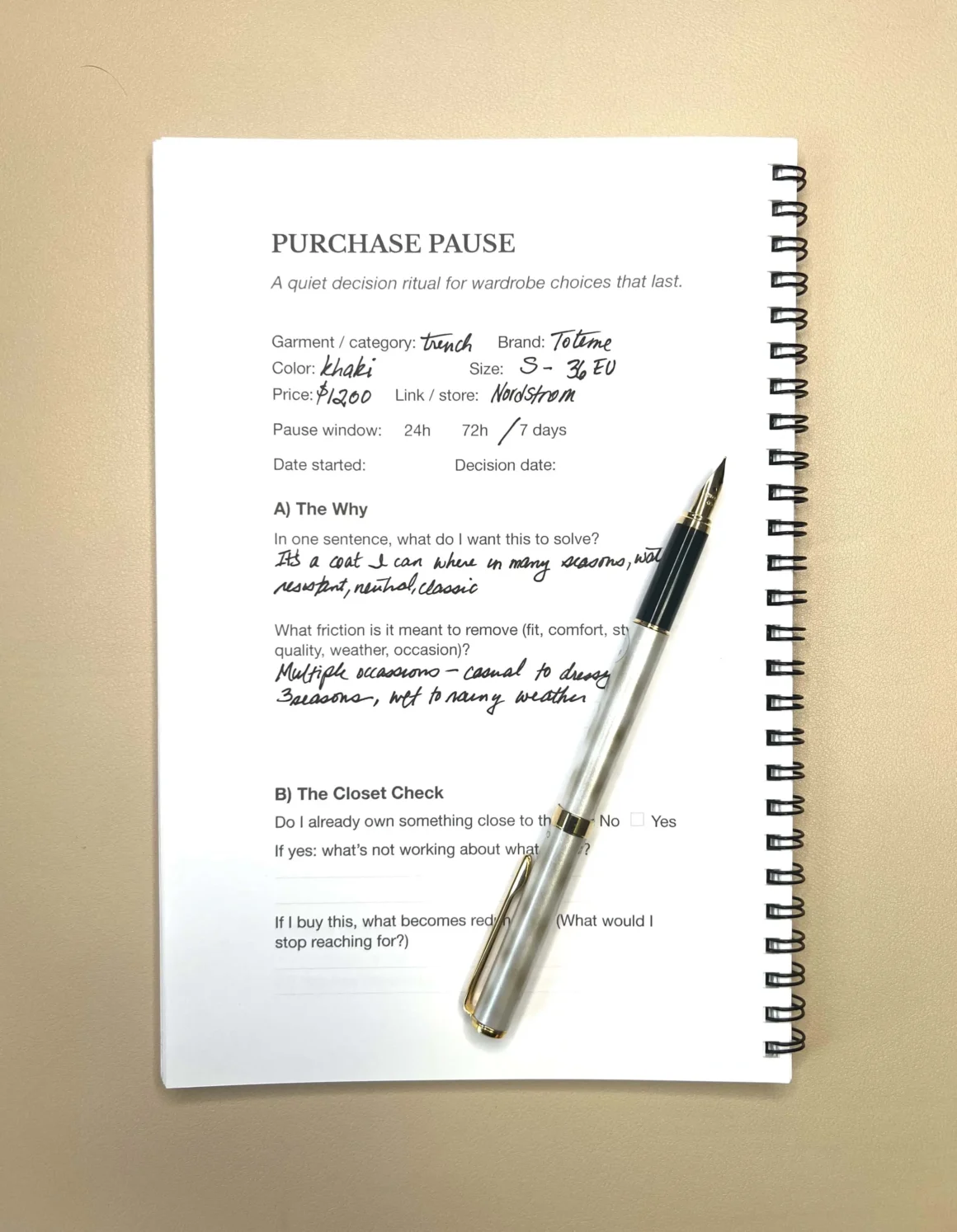
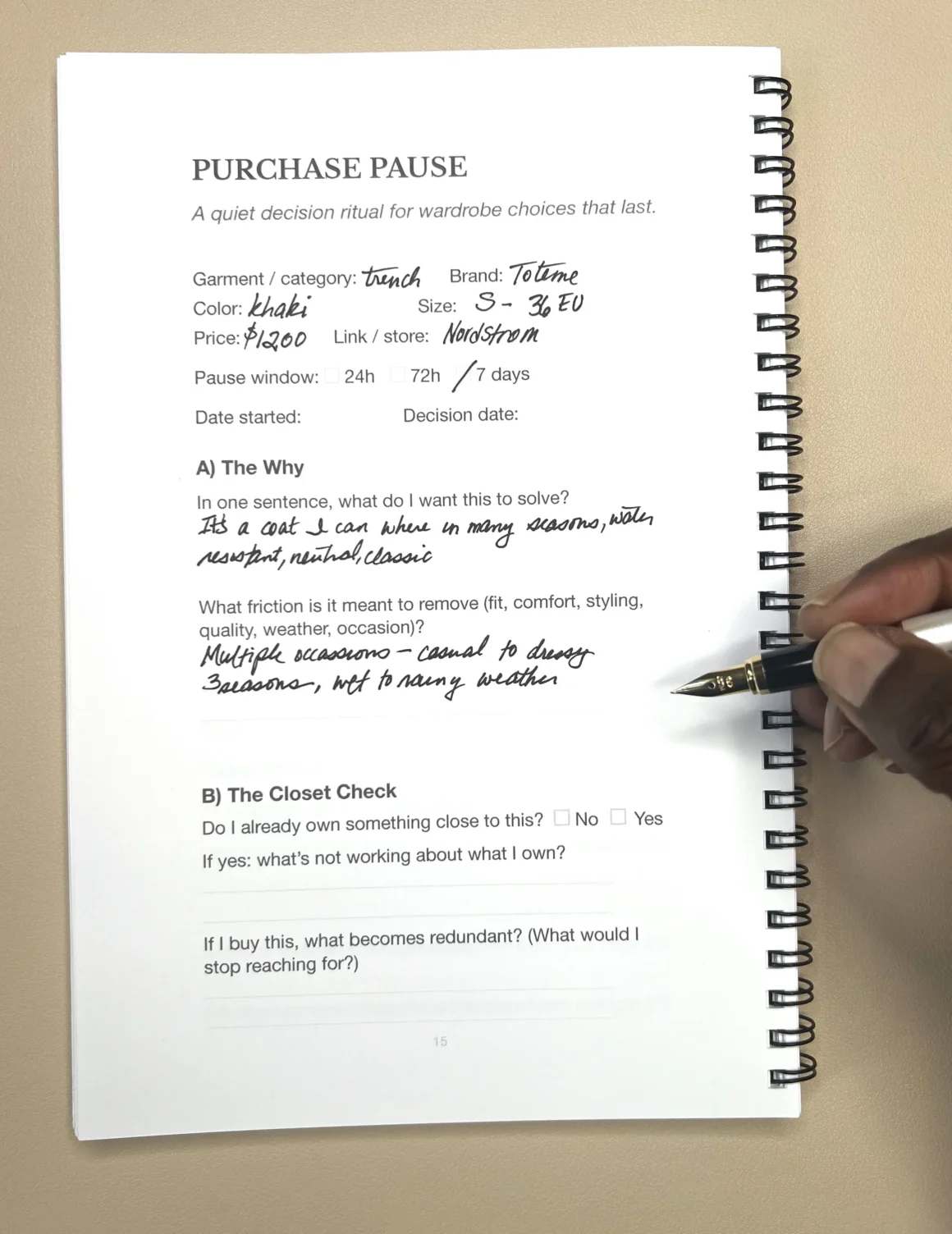
Instead of beginning with Should I buy this?, you can begin by recording the item, the reason it caught your attention, the role you imagine it playing, and the date you will reconsider it. That small act moves the purchase out of the realm of impulse and into a process you can observe.
Over time, the practice reveals more than the answer to one purchase.
You begin to notice recurring gaps, repeated cravings, favorite silhouettes, and the categories that attract your attention most often. You may discover that you consistently save the same kind of cardigan, that certain purchases tend to appear when you are bored or dissatisfied, or that the pieces you ultimately choose share more in common than you realized.
That information is useful because better shopping decisions rarely come from a single perfect question. They come from recognizing your own patterns.
A repeatable pause also makes the final decision less emotionally charged. You are no longer depending on the intensity of the moment to tell you what to do. You have created a place to return to the purchase when the pressure has softened and your judgment is easier to hear.
Sometimes the item will still deserve a yes. Sometimes it will become an obvious no. Sometimes it will remain on the waitlist until the answer becomes clearer.
All three outcomes are part of the practice.
The Purchase Pause Journal was created to give that practice a physical structure: somewhere to hold the questions, notice the patterns, and make the decision without surrendering the pleasure of wanting something beautiful.
The pause begins as a moment.
With practice, it becomes a way of choosing.
Better Decisions Need a Little Space
The space between wanting something and owning it may be brief, but it can change the quality of the decision entirely.
Without that space, urgency is allowed to speak first. The sale deadline, the low-stock warning, the imagined version of your life—all of it can become louder than the quieter question of whether the item truly belongs.
A purchase pause gives your own judgment time to re-enter the conversation.
It does not ask you to stop wanting beautiful things. It does not turn shopping into a test of discipline or require every purchase to be perfectly practical. It simply allows desire to exist without immediately becoming action.
The answer may still be yes. You may decide that the piece is useful, beautiful, meaningful, or simply worth choosing. But the yes feels different when it has survived the pressure surrounding it.
And when the answer is no, the pause has not deprived you of anything. It has protected your attention, your resources, and the wardrobe you are already building.
Better decisions rarely need more urgency.
They need a little more space.
That is what the Purchase Pause offers: not a reason to buy less, but a way to choose with greater clarity—and to trust the choices you make.
Frequently Asked Questions
The Purchase Pause
What is a purchase pause?
A purchase pause is an intentional space between wanting something and deciding whether to buy it. It gives you time to consider the item’s fit, usefulness, cost, and place within the wardrobe you already own before urgency or novelty makes the decision for you.
How long should I wait before buying something?
The pause should match the significance of the decision. An overnight pause may be enough for a familiar replacement, while an expensive, discretionary, or difficult-to-return purchase may deserve several days or weeks. The goal is to wait long enough for urgency to settle and useful questions to emerge.
Is a purchase pause the same as a shopping ban?
No. A shopping ban begins with the assumption that you should not buy. A purchase pause leaves both answers available. It may lead to a clear no, a better alternative, or a thoughtful yes. Its purpose is not to restrict you, but to return the decision to you.
What if the item sells out while I am waiting?
A sold-out item can create urgency that was not present before, but scarcity does not necessarily mean the purchase would have been right. Allow the disappointment to settle before searching for a replacement. Another opportunity may appear, or you may realize that the item mattered more once it became unavailable than it did while you could still choose it.
Can a purchase pause help with impulse shopping?
Yes. A pause interrupts the momentum between discovery and checkout, giving you time to separate genuine interest from the excitement of something new. Used consistently, it can also reveal recurring patterns, such as emotional shopping, unnecessary duplication, or purchases driven primarily by sales and scarcity.
How do I know when the answer should be yes?
A thoughtful yes usually becomes clearer once the pressure has faded. The item still appeals to you, suits your real life, works with what you own, and feels reasonable within your priorities. It does not have to be essential or perfectly practical; it simply needs to remain something you deliberately choose.
From pausing a purchase to trusting your choices.
The Purchase Pause is one part of a more intentional way of choosing. Continue with the ideas that help you create distance from urgency, recognize when you already have enough, and make better use of what you already own.

